









By Fan Haotian, People’s Daily
Inside a workshop of Yangtze Optical Fiber and Cable Joint Stock Limited Company (YOFC) in Wuhan, central China’s Hubei province, dozens of optical fiber drawing towers, each more than 30 meters tall and spanning five floors, operate around the clock. From the top of these towers, optical fiber as thin as a strand of hair is drawn continuously at a speed of 3,500 meters per minute.
“During high-speed fiber drawing, production conditions fluctuate constantly. Traditional manufacturing processes cannot always adjust quickly enough, which can lead to fiber breakage and product waste,” said Gu Lixin, president of the research institute under YOFC.
“By applying AI algorithms, we have developed a multi-strategy fiber-drawing control system that monitors production conditions in real time and automatically selects the optimal control strategy and process parameters,” Gu noted.
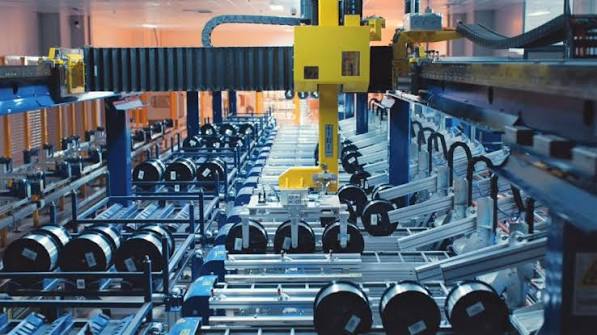
Today, AI is applied in more than 80 percent of operations at YOFC’s smart factory, supporting the efficient parallel production of hundreds of types of optical fiber and cable products. The facility has been recognized by China’s Ministry of Industry and Information Technology as one of the country’s first 15 flagship smart factories.
With optical fiber already widely used in homes and businesses, one might ask: is it still necessary to build a state-of-the-art smart factory to manufacture it?
For Gu, who has worked at YOFC for 26 years, the answer is clear: upgrading manufacturing capabilities remains essential.
Gu and his colleagues have witnessed the company’s transformation from reliance on foreign equipment, technologies, and raw materials to independently developing and manufacturing key optical fiber preforms, optical fibers, and optical cables.
They believe that only by boosting manufacturing capacities can market demands be translated into orders. In recent years, YOFC has invested at least 5 percent of its operating revenue in research and development each year, amassing over 1,300 patents at home and abroad.
However, the rapid expansion of the global internet industry slowed and growth in the international optical fiber market weakened, the company found itself at another crossroads. Optical fiber that once sold for 1,000 yuan ($147.65) to 2,000 yuan per kilometer now fetches less than 20 yuan.
Without upgrading, the company would be forced into fierce price competition in the low-end market. Building a smart factory offered a path forward, but it required enormous investment with uncertain returns. YOFC chose to take the risk.
The first challenge was changing people’s perceptions. Previously, workers manually loaded fragile optical fiber preforms onto machine tools. The process required extremely precise handling and smooth movement because even a slight mistake could shatter the preforms.
When the company proposed replacing manual loading with industrial robots, some production staff were skeptical. “They worried that if a robot malfunctioned and dropped a preform, it would hurt their production quality indicators for the month,” Gu recalled.
To build confidence, Gu and his team broke the robot’s loading operation into several smaller steps. After each movement, workers manually checked the robot’s performance before allowing it to proceed to the next step, essentially providing a demonstration for the machine to learn from.
Over time, the robots became increasingly accurate, stable, and efficient. “AI combined with big data has played a crucial role,” Gu said. “As production data accumulated and the algorithms continued to iterate, the system became increasingly intelligent.”
YOFC has since developed around 20 AI application scenarios, including an intelligent carbon footprint monitoring system for optical fiber and cable products, helping improve both manufacturing efficiency and product quality.
Years of manufacturing experience have also enabled the company to build a comprehensive production system covering technology, standards, platforms, talent development and equipment.
The system is now used not only in YOFC’s smart factories in China and overseas, but also to support companies throughout the industrial chain, including manufacturers of non-ferrous metals and automotive components, helping accelerate industrial collaboration.
Some have questioned whether sharing such expertise could create future competitors.
“Helping others is also helping ourselves — that’s what being a flagship means,” he said. “Sharing development experience helps reduce costs for both individual companies and the industry as a whole, while improving the efficiency and resilience of the entire industrial chain.”
By leveraging AI technologies, YOFC has built a flagship smart factory, and with optical fiber products, it is contributing to the development of the AI industry.
“The rapid development of AI is placing ever higher demands on computing power and data transmission,” said Zhuang Dan, executive director and president of YOFC.
Since last year, the company has introduced a range of new products, including hollow-core optical fiber, designed to meet the growing demand for ultra-high-speed, ultra-large-capacity and ultra-long-distance data transmission. By replacing the traditional glass core with an air-filled core, the new technology enables optical signals to travel even faster.


AI drives China’s flagship smart factory for optical fiber