








By Gu Yekai, People’s Daily
As artificial intelligence (AI) deepens its integration into manufacturing, its role is evolving from merely optimizing individual production processes to reshaping entire industrial value chains.
Across sectors ranging from automobile manufacturing and consumer goods to pharmaceuticals, AI is enabling companies to enhance quality, improve efficiency, and accelerate innovation
At the Maextro Super Factory, operated by Chinese automaker JAC Group, more than 150 previously independent AI quality inspection models have been consolidated into a single general-purpose model. This unified system was developed using Pangu CV (computer vision) large model and the Ascend AI computing platform, both created by Chinese tech firm Huawei.
Requiring only 50 to 100 sample images per workstation, the platform enables model fine-tuning and detects 99.99 percent of all defects.
“In the past, manual visual inspection inevitably missed some defects,” said Ding Zhihai, deputy general manager of JAC Group’s digital management center. “Now AI has taken over the inspection process. It applies consistent standards while continuously learning and improving.”
The solution has been deployed across more than 1,500 inspection scenarios throughout the Maextro production line, allowing a single AI model to support multiple production applications via a unified platform.
Today, the “AI+ Manufacturing” initiative is driving efficiency gains across an expanding range of industries. Rather than being limited to individual applications, AI is increasingly being integrated throughout entire production chains.
At Luzhou Laojiao, a company based in Luzhou, southwest China’s Sichuan province, specializing in the production, sale, and distribution of baijiu, disconnected production, marketing and retail data once caused system slowdowns during peak holiday sales periods, limiting operational efficiency and responsiveness.
With support from Huawei’s digital architecture, the company has modernized its data asset management system. By adopting an integrated “application + cloud” solution, it now manages more than 400 retail outlets nationwide while delivering a smoother customer experience.
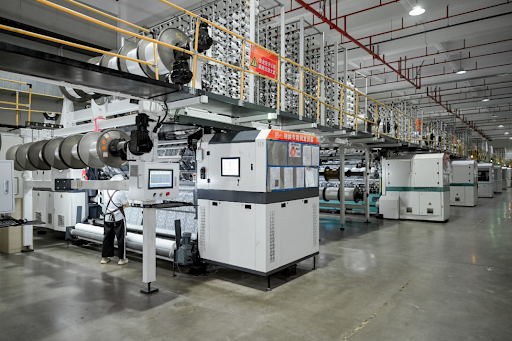
In the textile accessories sector, For Both, a textile company in southeast China’s Fujian province, has established a cloud-based computing platform that enables collaborative AI development. Cloud computing supports model training and optimization, while edge devices capture detailed production data in real time. Combined with AI applications tailored to specific manufacturing scenarios, the system has improved both product quality and production efficiency.
“The intelligent transformation of manufacturing is a systematic undertaking,” said Guo Zhenxing, vice president of Huawei’s China Government and Enterprise Business Department. “Only by addressing real industrial challenges and adapting to the realities of industrial production can manufacturers achieve higher quality and greater efficiency.”
AI is also reshaping pharmaceutical research and development.
“Early-stage discovery of small-molecule drugs used to take one to two years. Today, the process can be completed in just three to six months,” said Zou Binbin, chairman of a digital and intelligent technology company under Guangzhou Pharmaceuticals Corporation.
Using Huawei’s Ascend AI computing platform, industrial-grade 3D molecular generation models and AI-driven molecular generation and screening technologies, Guangzhou Pharmaceuticals Corporation has reduced the cost of early-stage drug discovery by 70 percent while significantly shortening research timelines.
Drug discovery has become one of AI’s most promising application areas.
In peptide drug development, Hybio Pharmaceutical Co., Ltd. has integrated more than 100,000 production-process records accumulated over more than 20 years with the Pangu drug molecular model of Huawei to build a proprietary knowledge base. The system transforms years of pharmaceutical expertise into reusable and continuously evolving digital assets, shifting research and manufacturing decisions from experience-based approaches toward data-driven and science-based decision-making.
As AI becomes more deeply embedded in manufacturing, its application is extending upstream into research and development, moving beyond operational support to become a true driver of value creation.
According to Guo, companies should select AI application scenarios based on their ability to create real value. Factors such as business impact, data availability, implementation costs, risks and technological readiness should all be evaluated to ensure that digital transformation delivers practical results.
Another example comes from Chinese automotive joint venture SAIC-GM-Wuling Automobile, which has partnered with Huawei to develop an “intelligent island” manufacturing system that re-imagines automobile assembly.
Unlike traditional linear production lines, the new system replaces fixed workstations with flexible production islands. AGVs (automated guided vehicles) move autonomously between work areas, allowing vehicles to be routed dynamically to available stations rather than waiting for fixed production positions.
Supported by Huawei’s Xinghe Intelligent Network, the AGVs operate without communication delays, enabling production lines to be rapidly reconfigured according to incoming orders and making flexible manufacturing possible.
“The AI-driven transformation of manufacturing is far more than a technological upgrade,” said Tao Jingwen, deputy chairman of Huawei’s Supervisory Board. “It requires deep integration between technological innovation and industrial processes.”
“From Ascend providing the computing foundation, to open-source frameworks unlocking the capabilities of underlying hardware, and to operating systems connecting different devices, data and applications, Huawei is committed to providing a secure, reliable and sustainable foundation for the digital and intelligent transformation of manufacturing,” Tao added.


AI transforms manufacturing, unlocking new growth opportunities