











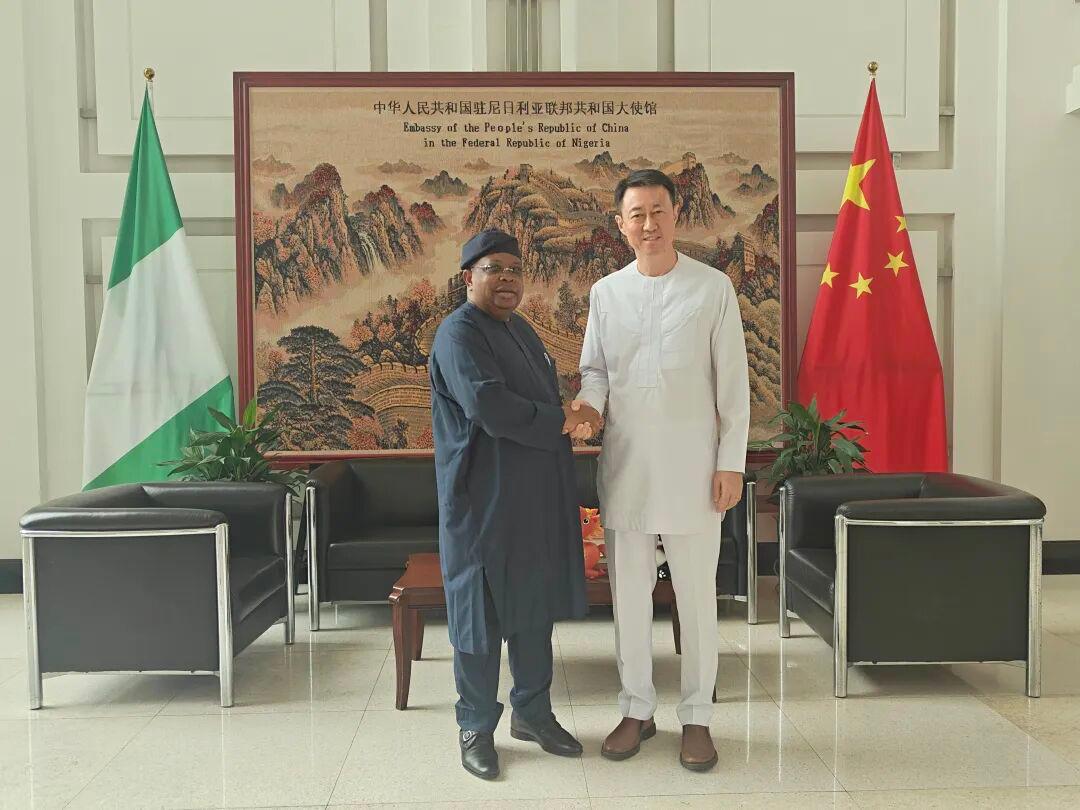
Stakeholders in diplomacy, academia and the media have restated Nigeria’s continued commitment to the One-China Principle, describing it as the cornerstone of the long-standing strategic relationship between Nigeria and the People’s Republic of China.
The reaffirmation came during a Media Salon on the One-China Principle held at the China General Chamber of Commerce in Nigeria in Abuja, with the theme: *“Understanding the One-China Principle and Its Role in Deepening China–Nigeria Strategic Relations.”*

The programme was organised by the Centre for China Studies and the Centre for Contemporary China-Africa Research, in collaboration with the Chinese Embassy in Nigeria.
### China reaffirms position on Taiwan
Speaking at the event, Counsellor of the Chinese Embassy in Nigeria, Dong Hairong of the Chinese Embassy in Nigeria, said the international community must maintain consistency on the Taiwan question, insisting that Taiwan remains part of China under international law and United Nations Resolution 2758.
She cautioned against what she described as misleading narratives from Taiwanese authorities, arguing that such positions undermine global consensus and regional stability.
Dong further referenced recent diplomatic engagements involving Taiwan, including activities linked to its leadership abroad, and urged strict adherence to Nigeria’s longstanding diplomatic stance.
She noted that since the establishment of diplomatic relations in 1971, Nigeria has consistently recognised the People’s Republic of China as the sole legitimate government of China.
The envoy also recalled President Bola Ahmed Tinubu’s state visit to China in September 2024, during which Nigeria reaffirmed support for China’s sovereignty and territorial integrity under the Bola Ahmed Tinubu administration.
According to her, the One-China Principle remains the political foundation of relations between both countries, which have expanded into a comprehensive strategic partnership covering trade, infrastructure, and development cooperation.
### Expanding economic cooperation
Dong highlighted recent collaboration projects, including the new ECOWAS headquarters complex in Abuja built with Chinese support, and China’s introduction of zero-tariff access for exports from 53 African countries with diplomatic ties to Beijing, including Nigeria.
She said the policy is expected to boost Nigerian agricultural exports such as sesame, ginger, cocoa, and cashew nuts into the Chinese market.
She also urged Nigerian journalists to adopt accurate and consistent terminology when reporting Taiwan-related issues, warning against language that implies sovereignty for Taiwan.
### African support for One-China Principle
Director of the Centre for Contemporary China-Africa Research, Prof. Sheriff Ghali Ibrahim, said global backing for the One-China Principle remains overwhelming, noting that 53 out of 54 African countries maintain relations with Beijing.
He argued that Taiwan does not meet the criteria of a sovereign state under international law and said most countries in Africa, Asia, and Latin America align with the One-China position.
He also commended China’s long-term approach to the Taiwan question, describing it as patient and consistent, rooted in peaceful reunification efforts under successive leadership from Mao Zedong to Xi Jinping.
### Legal and diplomatic perspectives
Legal scholar Prof. Sam Amadi distinguished between the One-China Principle and the One-China Policy, explaining that while they are often used interchangeably, they carry different diplomatic meanings.
He noted that the principle reflects China’s assertion of sovereignty over Taiwan, while the policy describes how other countries engage with that position in practice.
Amadi added that many states maintain what he described as strategic ambiguity—recognising Beijing officially while continuing informal economic engagement with Taiwan.
He advised African countries to avoid formal diplomatic ties with Taiwan, while ensuring that trade relations do not conflict with existing commitments to Beijing.
### Calls for deeper understanding and cooperation
Other participants, including Charles Onunaju, Segun Showunmi, and Prof. Mukhtar Imam, called for stronger public education on the One-China Principle and deeper cooperation between Nigeria and China in trade, infrastructure development, cultural exchange, and diplomacy.
They stressed that improved understanding would help strengthen bilateral relations and support ongoing economic and infrastructural collaboration between both countries.
