









By Chen Yuanyuan, Hu Xiaoyuan, People’s Daily
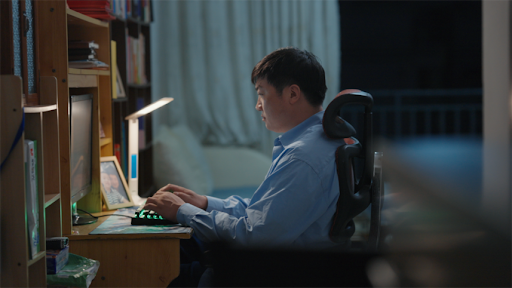
Zhao Kang works as a bus maintenance technician in Chongqing, a sprawling municipality in southwest China. Each morning at 8 a.m., dressed in dark blue work overalls, he heads to the garage, crawls beneath buses, and uses wrenches to tighten bolts and repair engines. But by 8 p.m., at home in front of his computer, he transforms into something else entirely: Ouyang Xiaoyao, an online novelist crafting vivid tales of martial arts heroes.
“My wrench earns my livelihood; my writing nourishes my soul,” Zhao always says.
Over more than a decade, he has penned over 20 million Chinese characters, covering urban stories and xianxia fantasy. Most of his protagonists are ordinary people who persevere against adversity. Drawing inspiration from his family and colleagues, he creates lifelike characters that embody the resilience of everyday people.
As of the end of 2025, China boasted more than 33 million online literary works and 525 million readers, with the online literature industry generating about 49 billion yuan (around $7.26 billion) in revenue.
The figures reflect not only the scale of the industry but also a flourishing cultural prosperity. Online writers come from all walks of life, including delivery workers, retired teachers, prosecutors and farmers. Together, they are participating in an unprecedented new form of popular literary practice.
According to a recently released blue paper on China’s online literature for 2025, online literature represents a typical form of popular arts in the internet era, enabling literary participation on an unprecedented scale. As of the end of 2025, China had more than 35 million registered online writers, reflecting the remarkable vitality of public participation in creative writing.
“As ordinary people’s lives are transformed into audio, images, text and videos, they come together to create the rich diversity of content online. It’s like countless stars lighting up the night sky — a reflection of the vibrant era we live in,” said online novelist Ban Cai Ming Yue.
In recent years, growing numbers of amateur writers and professionals from all walks of life have begun publishing on platforms such as WeChat, Xiaohongshu (RedNote), Douban, Zhihu, Douyin and Kuaishou. As a result, digital-native writing has flourished, making creative expression an everyday activity rather than an ideal reserved for a few.
For many years, Chinese online literature was often associated with fantasy adventures or billionaire romance stories. That stereotype is now giving way to a far more diverse literary landscape.
The blue book shows that as of 2025, China had nearly 2 million realistic-themed online literary works, with around 140,000 new titles unveiled during that year. Realistic creation has also expanded into diverse genres including science fiction.
China boasts 525 million online literature readers, accounting for nearly half of the country’s internet users. Works covering themes from rural revitalization and technological innovation to traditional Chinese culture stand out among readers. Delicate narratives depicting ordinary people’s daily routines, office life and rural realities strike a chord with large audiences.
One example is online writer Teng Ping, who has served as a police officer with the exit-entry administration of the Xiamen Public Security Bureau in southeast China’s Fujian province for more than two decades. Her experience on the job has given her a close view of society and inspired deeper reflections on good and evil. “My work and my writing constantly enrich each other,” she said.
According to the blue book, works rooted in contemporary life are becoming increasingly sophisticated, with writers placing greater emphasis on authentic experiences and more nuanced storytelling.
Li Wei, a professor at the School of Chinese Language and Literature at Nanjing Normal University, said that the strength of realistic online fiction lies in presenting serious social themes through the accessible, fast-paced and engaging narrative style that online readers enjoy, thereby expanding literary choices for the general public.
Unlike traditional publishing, where a book is considered complete once it reaches print, online fiction continues to evolve after publication. Reader comments — including chapter-by-chapter discussions and paragraph annotations — often influence how the story develops. Adaptations, fan fiction and other forms of derivative creation further extend a work’s life far beyond its original version.
“Going through readers’ comments is part of my daily routine,” said online novelist Liu Dan Pa Shui. When working on his novel Kuojin, he tried to confirm the surname of a historical figure’s mother but found no relevant records after thorough research. “Once the chapter went live, a reader noted in the chapter commentary section that this woman was a female calligrapher surnamed Fu.” The tip prompted him to craft an entirely new plotline.
As online literature evolves from a one-way relationship between writers and readers into an interactive process of co-creation, readers are becoming active participants in shaping stories.
Reaching hundreds of millions of readers, China’s online literature brims with vivid imagination and compelling stories, continuously fueling creative vitality. A new cultural landscape where anyone can become a creator is steadily taking shape.


Boom of China’s online literature: A vibrant landscape of mass creativity