









By Li Xinping, People’s Daily
In the age of artificial intelligence (AI), traditional infrastructure such as roads and bridges alone is no longer sufficient to support modern economic development. Computing networks and next-generation communication networks have become essential public utilities underpinning the digital economy.
China’s outline of the 15th Five-Year Plan (2026-2030) proposes the goal of building a modern industrial system and strengthening the foundations of the real economy. This system encompasses traditional industries, emerging and future industries, the services sector, and a modern infrastructure framework.
How can China build infrastructure that keeps pace with the development of new quality productive forces?
The answer lies in accelerating the planning and development of six key networks: the water network, the new-type power grid, the computing network, the next-generation communication network, urban underground utility networks and the logistics network.
Together, these six networks form the backbone of China’s modern infrastructure system and are an indispensable part of the country’s industrial transformation.
If the modern industrial system were a giant, then traditional industries, emerging industries and future industries would be its muscles and bones. The six networks would be the arteries and veins that connect and sustain the entire body.
How do these networks empower industrial development?
A visit to a “super factory” operated by Lovol, an agricultural equipment manufacturer in Weifang, east China’s Shandong province, offers a vivid example.
Inside the factory, an invisible 5G-Advanced (5G-A) network orchestrates the precise coordination of nearly 500 robots, achieving millisecond-level synchronization. A high-end intelligent tractor rolls off the production line every four minutes. At the end of the assembly line, AI-powered quality inspection systems detect millimeter-scale defects within milliseconds.
This example demonstrates how the six networks are transforming traditional industries. The computing network and next-generation communication network function as the industrial “nervous system,” enabling manufacturing lines to achieve precise sensing and intelligent decision-making.
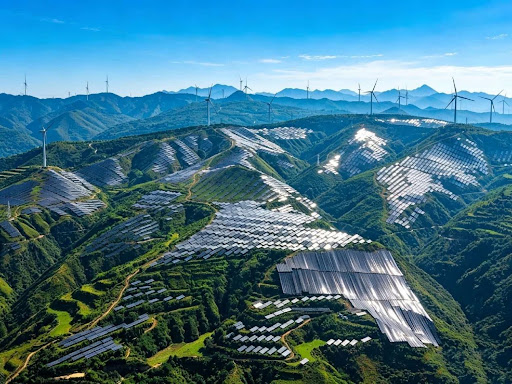
Meanwhile, the new-type power grid allows more manufacturing facilities to operate on green electricity, supporting the transition toward greener production.
For emerging industries, the six networks provide the “wings” for takeoff.
In Jiangning district of Nanjing, east China’s Jiangsu province, the first urban low-altitude logistics route was launched last year.
Previously, drones flying over longer distances could lose their bearings when switching between base stations, causing delays. Today, thanks to 6G cell-free networking technology, the entire 7.4-kilometer route enjoys uninterrupted signal coverage. Drones now complete deliveries in roughly half the time required by ground vehicles.
This is a clear example of the deep integration between the next-generation communication network and the logistics network. Together, they not only remove bottlenecks in urban-rural logistics but also create vast new opportunities for emerging industries such as the low-altitude economy.
Future industries likewise depend on the fertile foundation provided by the six networks.
The integration of the next-generation communication network, the computing network, and the new-type power grid is essential to nurturing industries of the future.
Ultra-low-latency communications make it possible to transmit massive volumes of neural data, helping brain-computer interface technologies move from science fiction toward practical application. The computing network enables AI-powered bio-manufacturing, transforming research and development from a process of trial and error into one driven by precise prediction.
Meanwhile, hydrogen energy, nuclear fusion energy, and sixth-generation mobile communications are not only important components of the six-network initiative but also key sectors within China’s future industries.
By advancing these networks, China is creating demand-driven pathways for technological innovation while fostering the growth of future industries.
Alongside these visible enablers are the less visible but equally vital networks. The water network serves as the lifeline for industrial production and modern agriculture
Urban underground utility networks provide the secure and resilient infrastructure foundation that supports economic activity in cities.
These six networks are closely interconnected. They facilitate the efficient flow of resources, strengthen the industrial system and improve the overall efficiency of the economy. Together, they are connecting China’s economy into a more dynamic, resilient and integrated whole.


China builds six networks to power its modern industrial system