











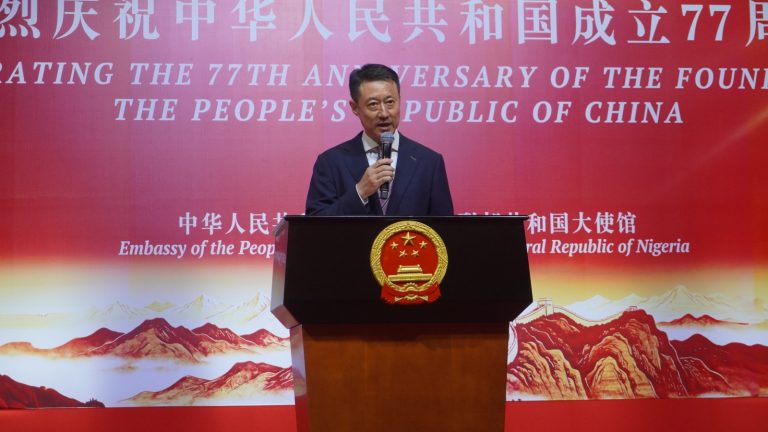
China-Nigeria bilateral trade reached $18 billion in the first half of 2026, representing a 35 per cent increase compared with the corresponding period in 2025, Chinese Ambassador to Nigeria, Yu Dunhai, has said.
Yu disclosed this on Wednesday in Abuja at a reception organised by the Chinese Embassy in Nigeria to commemorate the 77th anniversary of the founding of the People’s Republic of China.

The event brought together officials of the Chinese Embassy, Nigerian government representatives, members of the diplomatic community, business leaders and journalists.
The ambassador said the growth in bilateral trade was accompanied by a significant increase in Chinese imports from Nigeria, which rose by 81 per cent during the period.
According to Yu, the development reflected growing momentum in economic cooperation between the two countries, which marked 55 years of diplomatic relations in 2026.
“Our relationship has entered the fast lane,” he said, adding that China welcomed the economic reforms and other measures being implemented by the administration of President Bola Ahmed Tinubu.

He said recent agreements on economic partnership and aquatic exports had provided additional institutional support for expanding bilateral trade.
Yu also highlighted China’s decision to extend zero-tariff treatment to 53 African countries from May 1, 2026, saying Chinese imports from Africa increased by 24 per cent in May and June.
He said the policy could help African countries convert their resource advantages into greater industrial capacity and support the objectives of the African Continental Free Trade Area.
On bilateral cooperation, Yu said China was prepared to align its 15th Five-Year Plan with Nigeria’s Renewed Hope Agenda in areas including industrialisation, digital development, and the green and blue economies.
He also invited Nigeria to join the World Artificial Intelligence Cooperation Organization, saying participation would provide an avenue for the country to contribute to and benefit from developments in artificial intelligence and other emerging technologies.
The ambassador said China and Nigeria had also expanded cooperation beyond trade and investment to cultural and media exchanges, citing the introduction of Chinese-language broadcasts on Federal Radio Nigeria and Voice of Nigeria.
Speaking at the reception, Nigeria’s Minister of Power and Director-General of the Nigeria-China Comprehensive Strategic Partnership, Joseph Tegbe, commended China’s contribution to Nigeria’s infrastructure development.
He cited projects including the Lekki Deep Sea Port, railway modernisation and the Zungeru Hydropower Station as examples of cooperation between the two countries.
Tegbe said Nigeria needed to translate increased access to the Chinese market into stronger domestic production and higher export volumes.
The minister also reaffirmed Nigeria’s commitment to the One-China principle, stating that the Nigerian government recognises the Government of the People’s Republic of China as the sole legal government representing the whole of China.
Nigeria and China established diplomatic relations on February 10, 1971. In September 2024, President Bola Ahmed Tinubu and Chinese President Xi Jinping elevated bilateral relations to a comprehensive strategic partnership.
