








By Qi Yukun, Shen Tongrui, People’s Daily
At around 10:30 a.m. on Aug. 26, a severe mudslide triggered in Nepal caused major casualties and left several people missing at the Gyirong Port in Gyirong county, Xigaze, southwest China’s Xizang autonomous region.
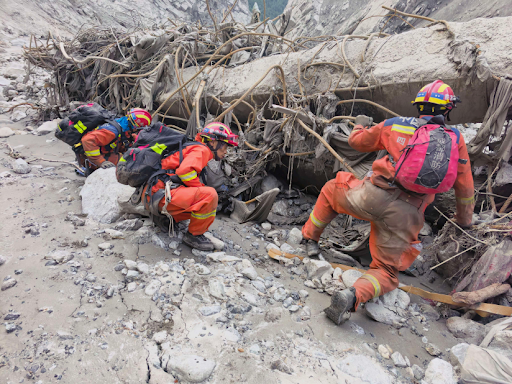
The valley shook as rocks and debris lay scattered across the landscape. The main road leading to the worst-affected area was buried under the mudslide, while secondary hazards, including falling rocks, landslides, and the overflow of a barrier lake, continued to pose serious risks to rescue operations.
China’s national comprehensive fire and rescue force quickly mobilized to search for and rescue those who remained unaccounted for. Following every lead and searching every possible area, the rescuers left no stone unturned.
“The roads are completely cut off, leaving us without predefined search paths. We have no choice but to launch multiple search operations simultaneously,” said Wang Haitao, commander-in-chief of the on-site fire and rescue command center.
Breaking down organizational barriers among different units, the command center divided the operation into three specialized teams for land, water, and air searches. A coordinated, three-dimensional approach was adopted: teams advanced on foot across difficult terrain, boats pushed forward along waterways, and aerial equipment conducted reconnaissance and delivered supplies — all aimed at maximizing search coverage.
— On land, firefighters trek through dense forests and steep mountains.
Carrying life detectors, satellite communication equipment, and other search-and-rescue gear, rescuers made their way through mountain forests where slopes approached 60 degrees.
The ground beneath them was slippery with mud, falling rocks threatened from above, and many sections had no passable roads at all. Using both hands and feet, the rescuers clung to rock faces and shrubs as they painstakingly made their way forward. On particularly dangerous cliff sections, they had no choice but to use ropes to rappel down to reach the target areas.
“Knowing that there were still people waiting to be found, none of us stopped,” said rescuer Xu Hui.
After reaching the hardest-hit area with his teammates, Xu immediately joined a systematic, grid-by-grid search without pausing to rest.
— On water, inflatable boats navigate rushing currents.
The river was fast-flowing, with rocks scattered throughout the channel and muddy water hiding dangerous currents beneath the surface. At any moment, the boats could collide with rocks or be swept into powerful currents.
“Conditions in the water can change in an instant. We have to be bold enough to move forward, but we also have to proceed with caution. We carefully assess the risks along every section of the waterway,” said Benpa Tsering, head of the water search-and-rescue team.
Because sediment had accumulated along the riverbed, the boats could not reach every section directly. Rescuers often had to leave their boats and go ashore to conduct thorough searches along riverbanks, shoals and backwater bends.
The high altitude quickly drained the rescuers’ strength, while intermittent rainfall continued to heighten geological risks. Every step forward in the search and rescue operation required tremendous effort.
— In the air, drones conducted reconnaissance and delivered equipment.
Mountain ridges blocked the view and created numerous communication blind spots for ground teams, making aerial operations crucial to filling information gaps .
At the site, multiple drones took turns flying nonstop reconnaissance missions. Thermal imaging payloads detected faint heat signatures in buried areas, while mapping modules rapidly generated three-dimensional models of the disaster zone, providing the command center with a clear view of terrain and signs of burial that could not be seen from the ground.
“We transmit aerial images and three-dimensional models back to the command center in real time, allowing commanders to see the entire valley at a glance and avoid deploying personnel blindly,” said commander Wang Yongming.
Weather conditions can change rapidly in high-altitude valleys, and drone operators must contend with strong winds, signal attenuation and other challenges, repeatedly adjusting flight altitudes and routes.
Through a closed-loop operational process of risk assessment, task organization, on-site operations, and review and evaluation, the rescue teams have established a systematic approach to search and rescue.
“Although dangers keep emerging, as long as there is even the slightest hope, we will never stop searching,” said rescuer Zou Mingqi, his clothes and body covered in mud, his voice firm and resolute.


China steps up rescue efforts after massive mudslide strikes border port in Xizang