









By Liu Zhiqiang, Yao Xueqing, People’s Daily
China’s shipbuilding industry has continued to make significant strides in the global market. In the first quarter of this year, the country’s shipbuilding output, new orders and order backlog increased by 46.0 percent, 195.2 percent and 43.6 percent year-on-year, respectively. China now accounted for 57.3 percent of global ship completions, 84.9 percent of new orders, and 69.8 percent of the global order backlog, reinforcing its leading position in the sector.
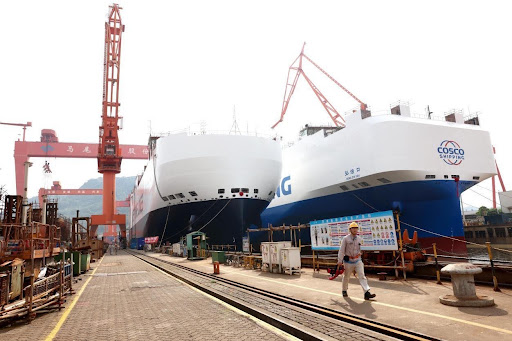
Today, major shipbuilding hubs such as Dalian in Liaoning province, Nantong in Jiangsu province, Shanghai and Guangzhou in Guangdong province are operating at full capacity. Many leading shipbuilders have already secured orders extending through 2030. This robust production and sales momentum reflects sustained growth in global market demand.
Shipbuilding is a highly cyclical industry. “Since 2021, the global new shipbuilding market has experienced five consecutive years of growth. Shipyards in the world’s major shipbuilding countries have accumulated full order books, and Chinese companies have seized this opportunity to further consolidate their leading position,” said Zheng Yiming, assistant to the secretary-general of the China Association of the National Shipbuilding Industry (CANSI).
Several factors have contributed to the recovery of the global shipbuilding market. As the average age of the world’s commercial fleet continues to rise, demand for fleet renewal has increased.
Meanwhile, the International Maritime Organization’s vision of achieving net-zero greenhouse gas emissions from international shipping by around 2050 has accelerated the replacement of existing vessels. Geopolitical conflicts have also driven stronger demand for liquefied natural gas (LNG) carriers and oil tankers.
Although market demand inevitably fluctuates, China’s ability to seize opportunities and sustain its momentum ultimately rests on its growing technological and industrial strength.
Hudong-Zhonghua Shipbuilding Group, a subsidiary of China State Shipbuilding Corporation (CSSC), currently holds nearly 60 LNG carrier orders under construction or awaiting construction, ranking first globally by total cargo capacity on order. Its product portfolio now covers the full range of conventional large and ultra-large LNG carriers.
These orders underscore the company’s leading position in the LNG carrier market. Having progressed from introducing and assimilating foreign technologies to becoming a global technology leader in multiple areas, Hudong-Zhonghua has joined the world’s top tier of LNG shipbuilders. It has also reduced the construction cycle for a 174,000-cubic-meter LNG carrier to 16 months, setting a new global benchmark.
China is now capable of designing and building an increasingly comprehensive range of high-end vessels to an ever-higher standards.
From ultra-large LNG carriers and polar icebreaking research vessels to domestically built aircraft carriers and large cruise ships, China has developed full-spectrum design and construction capabilities for both marine and offshore equipment. This provides a solid foundation for capturing new opportunities arising from the global shipping industry’s green transition and the latest upcycle in the shipbuilding market.
A closer look at China’s shipyards reveals that years of technological progress across the industry have collectively driven a major leap forward.
Chinese shipbuilders have continued to advance green and low-carbon technologies while developing increasingly sophisticated vessel types. A series of high-end, intelligent and environmentally friendly ships has entered service, including dual-fuel passenger roll-on/roll-off ferries, large LNG dual-fuel vehicle carriers and very large ethane carriers, all of which have now entered batch production and delivery.
In the field of specialized marine equipment, China has also delivered a number of advanced products, including large deep-sea aquaculture vessels, rocket recovery ships and green intelligent technology demonstration vessels for deep-sea operations.
For shipbuilders, improving efficiency through shorter delivery cycles and lower production costs is essential to maintaining competitiveness.
In recent years, leading Chinese shipyards have introduced advanced manufacturing equipment, including robotic cutting lines for plates and steel sections, intelligent coating production lines, digital welding systems and flexible robotic welding technologies. Improvements in individual production processes have enhanced efficiency across the entire manufacturing chain, significantly reducing both construction time and production costs.
Marine engines, often described as the “heart” of large oceangoing vessels, have also achieved major breakthroughs. An eight-cylinder 450DF dual-fuel diesel engine, developed by CSSC Marine Power Zhenjiang Co., Ltd., has recently been delivered. It boasts a single-cylinder power of 1,150 kW and an aggregate power of 9,200 kW. Ninety-five percent of its components are developed in China. It fills China’s technological gap in high-power medium-speed marine engines.
Shipbuilding is a complex systems engineering undertaking involving huge numbers of components, long industrial chains and strong spillover effects across related industries.
In recent years, closer collaboration among shipbuilders, component manufacturers, equipment suppliers and end users has accelerated technological breakthroughs. Domestically developed marine engines, marine boilers, shipboard cranes and gas supply systems have all achieved significant progress, further strengthening the competitiveness of China’s shipbuilding ecosystem.
According to Li Yanqing, CANSI’s vice chairman and secretary-general, strong global demand, stable RMB exchange rates that support exports, and relatively low steel prices have all contributed to the industry’s positive performance.
“However, for an industry as cyclical as shipbuilding, the more important question is how to build stronger long-term competitiveness and successfully navigate future market cycles,” Li said.
Industry experts believe that while ensuring the timely delivery of existing orders, China’s shipbuilding industry should continue cultivating new sources of growth.
On the technological front, the industry should accelerate the integration of artificial intelligence into shipbuilding and further strengthen indigenous innovation capabilities. From a business perspective, companies should continue to innovate their management concepts, improve service quality, and expand their international operations.


China strengthens its global leadership in shipbuilding