









By Gu Yekai, People’s Daily
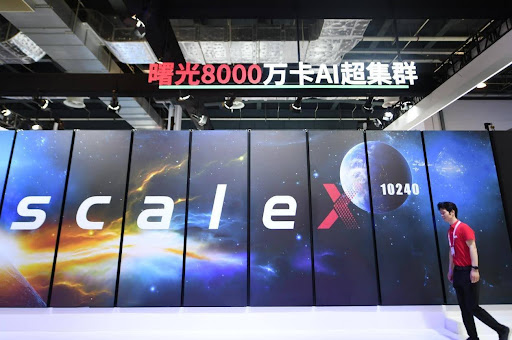
Recently, Dawning 8000, China’s first all-domestic 100,000-card AI supercluster, has been completed and put into operation at the national supercomputing internet core node in Zhengzhou, central China’s Henan province. This marked the beginning of a 100,000-card deployment stage for China’s computing infrastructure development.
In its first week of operation, Dawning 8000 reached full utilization, processing an average of 150,000 computing jobs per day, with a peak daily workload exceeding 500,000 jobs. The system has already completed compatibility testing for a wide range of integrated supercomputing and intelligent computing applications, supporting scenarios including large model training, high-throughput inference, and scientific computing.
Both supercomputing and intelligent computing are essential for processing massive datasets and advancing cutting-edge science and technology.
Supercomputing primarily serves scientific research, tackling major scientific and engineering challenges that require high computational precision, such as weather forecasting, aircraft design, and earthquake simulation.
Intelligent computing, on the other hand, focuses on AI algorithms and model innovation. While it places less emphasis on numerical precision, it prioritizes performance to support applications such as large model training, natural language processing, and autonomous driving.
As large AI models grow larger, computing scenarios become increasingly complex, and AI applications expand rapidly, there is an urgent need for a new generation of computing infrastructure capable of handling high concurrency, high throughput, mixed precision, and multi-task workloads.
Dawning 8000 was developed specifically to meet this demand. As a supercluster, it interconnects tens of thousands of computing cards at ultra-high speed, logically integrating them into a single, centrally scheduled “mega computer,” delivering massive parallel computing power.
“Dawning 8000 adopts a supercomputing-AI fusion architecture, combining high-precision scientific computing with lower-precision intelligent computing on the same platform,” said Li Bin, senior vice president of Chinese tech firm Sugon, which developed the supercluster.
“It supports computing precision ranging from 64-bit double precision down to 32-bit, 16-bit, 8-bit, and even lower, while providing flexible mixed-precision scheduling to meet the needs of scientific research, large model training, AI inference, and industrial simulation.” Li added.
The system is a true engineering marvel. It integrates three billion electronic components, incorporates over 1,600 kilometers of interconnection cables, and weighs approximately 1,500 tons. Yet the entire system had to be assembled with a structural precision of less than 0.05 millimeters—thinner than a sheet of A4 paper.
In terms of system development, Dawning 8000 features a fully self-developed domestic AI infrastructure spanning the entire technology stack, including chips, computing, storage, networking, cooling, applications, and services. Every stage, from the development of core components to full system deployment, has been achieved with domestically developed technologies.
“Scaling up from 10,000 to 100,000 accelerators is far more than simply multiplying the number of devices by 10. The real challenge lies in ensuring that the expanded system delivers the performance and efficiency expected at such a scale, “Li said.
He explained that, in terms of computing coordination, as system architectures evolve toward increasingly complex heterogeneous computing, any bottleneck in either computing or networking nodes can significantly reduce overall performance.
Moreover, the sharp increase in the number of components raises the theoretical failure rate, while the greater complexity of the system architecture makes maintaining stable operation even more challenging.
China’s rapid progress in domestically developed AI chips and the underlying hardware and software ecosystem has provided strong support for the construction of Dawning 8000.
For example, the distributed storage technology used by the system topped both the production full-node and 10-node categories in the IO500 rankings, a global storage performance benchmark, released in June this year.
The storage system is capable of supporting the massive data read-and-write requirements of large model training and scientific computing, ensuring the efficient operation of large-scale computing clusters and demonstrating China’s world-leading capabilities in high-end storage technologies.
In addition, high-speed networking, digital twin-based operations and maintenance, and unified scheduling across heterogeneous computing resources have further enhanced the operational efficiency and application adaptability of ultra-large-scale clusters.
Industry experts believe that establishing a fully domestic technology stack from chips and complete systems to foundational software and intelligent applications, and building a new generation of intelligent computing infrastructure carries profound strategic significance.
Immediately after entering operation, Dawning 8000 was connected to the national supercomputing internet and, through it, integrated into China’s national integrated computing power network.
It now provides computing services to research institutions and industrial users, supporting applications including weather forecasting, materials design, energy exploration, biomedicine, quantum computing, fluid dynamics simulation, industrial simulation, and large model training and inference, while enabling broader nationwide computing resource coordination and application support.
The system has already completed deep adaptation for more than 300 key applications across over 20 industries.
China officially launched the national supercomputing internet in April 2024. It has since become the country’s largest integrated computing network and application service platform, bringing together more than 3.5 million CPU cores and 250,000 GPUs.
The platform now serves more than 1.4 million registered users, with the average user age continuing to decline, making high-end computing resources accessible to everyone from secondary school students to professional researchers.


China’s first fully domestic 100,000-card AI supercluster goes live