










By Liu He, Yu Limin, People’s Daily
As a fresh heatwave swept across Europe in mid-July, temperatures in parts of Spain, Italy, France, and other countries climbed above 40 degrees Celsius.
The prolonged extreme heat has driven demand for cooling appliances to record levels. Chinese-made air conditioners, portable fans and other cooling products have gained popularity among European consumers for their practicality, affordability and availability. Many European now describe these products as indispensable “heat-fighting essentials.”
According to International Energy Agency (IEA) data for 2025-2026, air conditioner ownership remains relatively low across Europe due to factors such as climate, housing design and installation costs. On average, only about 20 percent of European households have air conditioning. In Western European countries such as the United Kingdom and Germany, the penetration rate is just 3 to 5 percent.
As extreme summer heat becomes more frequent, air conditioning is rapidly becoming a necessity for many European households. At the same time, limited domestic manufacturing capacity has left Europe increasingly unable to meet growing demand.
On social media, many Europeans have shared their struggles to purchase air conditioners. Some said they drove 200 kilometers just to purchase a Chinese-made unit. In certain markets, resellers have driven up prices, with used air conditioners sometimes selling for more than new ones. Others have even traveled to China under the country’s transit visa-free policy specifically to purchase air conditioners and ship them home.
According to the Home Appliance Europe, the continent’s annual air conditioner production capacity is only about 3.2 million units, while annual demand exceeds 10 million units. Roughly two-thirds of the market therefore depends on imports.
Drawing on decades of manufacturing expertise and a highly efficient supply chain, Chinese brands have responded quickly to this surge in demand.
Data from Joybuy, an online retail platform in Europe operated by Chinese e-commerce giant JD.com, show that sales of air conditioners during the heatwave from June 19 to 25 were nearly 40 times higher than in the first week of June.
Chinese home appliance manufacturer Midea Group reported that shipments of its PortaSplit portable split air conditioner exceeded 200,000 units in 2026, with sales doubling from the previous year.
Hisense, another Chinese home appliance maker, said its sales in Western Europe rose by more than 20 percent in the first six months of the year, while sales in France more than doubled.
The growing popularity of Chinese cooling products is no longer driven simply by competitive pricing. Increasingly, it reflects technological innovation tailored to local needs.
Recognizing challenges such as Europe’s large stock of older buildings, high proportion of rental housing and expensive installation processes, Chinese manufacturers have redesigned products specifically for the local market.
Take Midea’s PortaSplit as an example. Officially launched in Europe in 2025, it is designed for easy installation while offering energy efficiency and quiet operation.
“From the mounting bracket to the main unit, the design minimizes the need for drilling or complex installation work,” said Tobias Strobel, head of technical innovation for residential air conditioning at Midea’s German R&D Center.
The outdoor unit is lightweight, while its adjustable mounting system can accommodate many common European window types, including roof windows, floor-to-ceiling windows and balcony windows, without altering the building’s structure.
The product reflects close collaboration between Chinese and European engineering teams. Combining China’s flexible manufacturing capabilities and technological expertise with German engineers’ understanding of local housing characteristics and regulatory requirements, the design addresses many of the practical challenges European households face when installing air conditioners.
Beyond traditional household appliances, a growing number of innovative cooling products from China is also winning over European consumers.
Cooling towels that chill rapidly after being soaked in water, waist-mounted hands-free fans, and sun umbrellas equipped with misting functions are among the products seeing strong online sales.
According to Amazon Europe, sales of portable fans, neck fans and compact air coolers have risen sharply month on month, with several products ranking among the platform’s best sellers.
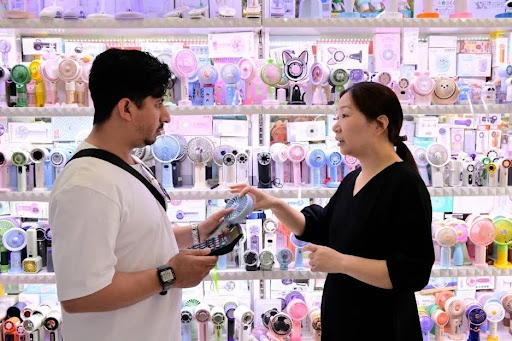
The Chinese Trade Center near Warsaw, Poland — one of the largest distribution hubs for consumer goods in Central and Eastern Europe — has seen a surge in activity. Magdalena, who runs a general merchandise store in Wroclaw, traveled all the way to the trade center to purchase merchandise.
“Temperatures exceeded 40 degrees Celsius this summer,” she said. “The small fans made in China are compact, powerful and affordable. They often sell out immediately after arriving on store shelves.”
The surge in demand has also become a major test of cross-border supply chains, logistics capacity and after-sales service. Alongside expanding their product offerings, Chinese companies are strengthening logistics networks and customer support across Europe.
For its fast-selling air conditioners, the logistics team of JoyExpress has introduced an integrated delivery-and-installation service. Before delivery, staff contact customers to confirm housing layouts and installation requirements. Delivery, installation, removal of old units and recycling can all be completed in a single visit. Customers experiencing product issues can also access round-the-clock after-sales support.
Now, JoyExpress’ “211” delivery model — offering same day delivery for orders placed before 11:00 am and next day delivery (before 3:00 pm) for orders placed before 11:00 am — reaches more than 30 European cities, including London, Paris, Cologne and Amsterdam, allowing over 40 million consumers to receive same-day delivery by ordering in the morning and receiving their purchases that afternoon.
Meanwhile, Cainiao, a top e-commerce supply chain solution provider under Chinese e-commerce giant Alibaba, has established 28 overseas warehouses across Europe, enabling cross-border merchants and brands to stock products locally and deliver orders to consumers in as little as two to three days.
From exporting products to exporting services, and from meeting demand to creating greater value, Chinese manufacturing is becoming more deeply integrated into the European market, contributing to better living standards and mutually beneficial development.


Chinese-made cooling products gain popularity in Europe