









By Ouyang Jie, Liu Junguo, People’s Daily
From factories and power plants to warehouses and emergency response sites, Chinese-made robots are increasingly being deployed across a wide range of applications worldwide.
This expansion reflects not only the rapid growth of China’s robotics industry but also the ability of Chinese companies to develop products tailored to diverse market needs, improve service capabilities, and build localized operations overseas.
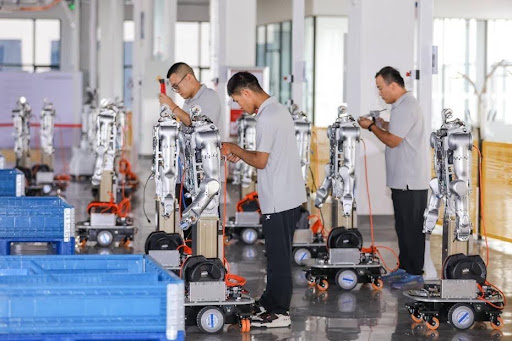
At the assembly workshop of Pudu Robotics, a Chinese service robotics manufacturer located in Jianhu county, east China’s Jiangsu province, five production lines were running at full capacity for 10 hours.
Workers at assembly stations were installing new batches of lidar modules into robot bodies. The company’s production schedule has already fully booked through 2027, with factory production plans significantly tighter than last year.
Founded in 2016, Pudu Robotics has focused on the global commercial service robot market. It has shipped more than 130,000 units and served over 50,000 end customers worldwide.
Since the beginning of this year, the company’s exports have already exceeded the total volume of the previous year, with products sold to 85 countries and regions. Its cleaning robots, in particular, have maintained year-on-year export growth of more than 100 percent for consecutive years, accounting for 29 percent of the global commercial cleaning robot market.
Pudu Robotics is just one example of Chinese intelligent robot companies expanding into overseas markets. According to customs data from Shenzhen, south China’s Guangdong province, exports of various types of robots from Shenzhen reached 6.94 billion yuan ($1.03 billion) in the first half of this year, representing a tenfold increase year-on-year. These products were shipped to more than 110 countries and regions.
Strong technological capabilities are at the core of the global competitiveness of Chinese manufacturing.
“Our quadruped robots have officially started operations at a nuclear power plant in Switzerland, carrying out frequent and routine autonomous inspections in high-risk areas,” said Yao Hengyan, assistant general manager of DEEP Robotics in Hangzhou, east China’s Zhejiang province.
The robot can climb slopes as steep as 45 degrees, navigate narrow spaces between equipment and access areas that are difficult for humans to reach. Equipped with thermal imaging and acoustic sensors, it can accurately detect potential hazards such as leaks, abnormal temperatures, and unusual equipment noises.
Inspection data is uploaded in real time to a digital management platform, which can automatically issue alerts and initiate responses once anomalies are detected.
Besides, the quadruped robots of the company are also used for factory security and underground pipeline inspection in Switzerland.
A diverse product portfolio has enabled Chinese robots to adapt to a broad range of global application scenarios.
Pudu Robotics has divided the market into 16 major industries and more than 800 categories of specific applications and tasks based on customer needs, said Zhang Tao, founder and CEO of the company. The company has continuously optimized the overall performance of its products to ensure they are “functional, user-friendly, and durable” in complex environments.
It has established four major product lines covering delivery, cleaning, industrial, and general-purpose embodied intelligence robots, with applications spanning multiple sectors, including manufacturing and warehousing logistics.
The successful deployment of DEEP Robotics’ quadruped robots at a Swiss nuclear power plant, where safety standards are extremely demanding, demonstrates the stability and reliability of China-made robots, Yao said.
The company has reached an agreement with its Swiss client to expand cooperation, and its robots, which can adapt to complex terrain and extreme weather conditions, have already been deployed in energy, industrial, and emergency response scenarios in various parts of the world.
As they continue to explore overseas markets, many Chinese robotics companies are shifting from simply exporting products to building localized brands and service networks.
Competition in China’s service robot sector has moved beyond price-performance advantages and entered a new stage where quality, brand recognition, and service capabilities are equally important, Zhang said. Customers are looking for not just a machine, but a comprehensive solution that can operate reliably over the long term.
To meet these needs, Pudu Robotics has established local offices and service centers in major global markets and built a cooperation network involving more than 1,000 distributors. The network provides partners with full-process support, including pre-sales consultation, sales assistance, deployment, after-sales maintenance, and rapid spare parts response, helping customers overcome concerns about adopting complex technologies.
The current penetration of robots remains relatively low, leaving broad room for future growth, Zhang said. As robots become increasingly integrated into various industries, different application scenarios will require different types of robots and capabilities. The company hopes to develop a unified “intelligent brain” for robots that can empower various products in fields such as delivery, cleaning, and industrial applications.
Pudu Robotics will continue expanding investment in technological innovation and product upgrades, making robots increasingly intelligent and capable of serving more industries worldwide, Zhang added.


Chinese robots expand global reach through diverse applications