








By Fang Jinglun
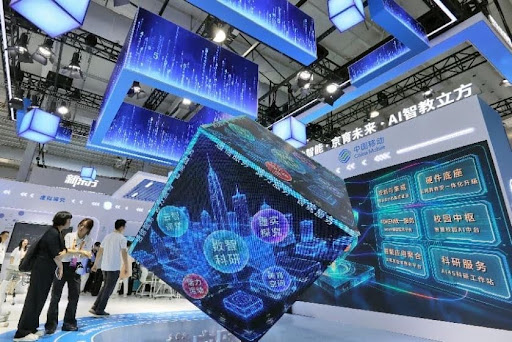
At the recently concluded 2026 China International Fair for Trade in Services (CIFTIS), a new cross-border service model captured widespread attention. Unlike physical goods shipped in containers, token exports represent a new form of trade in services, delivering computing power and AI intelligence to overseas users measured by AI tokens.
A token is the smallest unit of information processed by a large AI model. For context, generating an 800-character Chinese-language article using an AI tool consumes around 1,500 to 2,000 tokens.
As AI evolves from an “auxiliary tool” into a primary agent of productivity, China’s token exports are unlocking fresh opportunities on the global stage.
According to International Data Corporation, global daily token consumption surged nearly 300-fold in 2025. Meanwhile, figures published by OpenRouter, a global AI model aggregation platform, show that as of early August 2026, Chinese large language models have held the top position in call volume on leading platforms catering primarily to overseas users for 15 consecutive weeks.
What is driving the rapid growth of Chinese AI token exports? Several exhibitors at CIFTIS offered the same answer: coordination across the entire industrial chain. This synergy gives the sector advantages in large-model technology, computing costs, application scenarios, and data transmission, making the overseas expansion of AI services increasingly viable.
Adapting supply to demand to enter new markets.
“There is strong demand for technology and data in Southeast Asia’s AI-generated short-drama market,” said Jiang Linfeng, general manager of FZ Entertainment, a culture and communication company based in Nanning, south China’s Guangxi Zhuang autonomous region.
The company uses its self-developed generative AI platform to create customized video datasets for businesses in several Southeast Asian countries, tailoring content to local cultures and ensuring relevance to regional markets and preferences.
Cutting costs through technology to win new customers.
“Our computing infrastructure products and services help clients reduce costs and improve efficiency through open-source technologies. Over the past year, the number of clients seeking consultations on these products has increased several times over,” said Ran Hao, head of overseas technology at EasyStack, a Beijing-based provider of open-source cloud computing solutions.
Building infrastructure to support new business models.
“We have 256 network nodes overseas, including 15 self-operated internet data centers (IDCs) and more than 300 partner IDCs. We leverage these resources to provide the necessary support,” said Kang Yuanji, a solution manager at China Telecom Global, a Chinese internet access provider.
The full industrial chain synergy forged by China’s “East Data, West Computing” initiative, combined with direct green power access models and peak-shaving computing allocation mechanism, is driving marked reductions in the overall costs of the AI industry.
For example, thanks to the availability of green electricity, an “East Data, West Computing” industrial park in Qingyang, northwest China’s Gansu province has reduced the electricity price paid by end users to no more than 0.4 yuan ($0.06) per kilowatt-hour.
In June 2026, China’s National Data Administration issued an implementation plan promoting the development of high-quality datasets across industries. The plan calls for establishing and improving mechanisms for the secure and orderly cross-border flow of datasets and promoting mutual recognition of rules governing cross-border data flows. This regulatory support provides a foundation of rules and standards, paving the way for companies to participate in the global data ecosystem.
“Since the second quarter of this year, we have seen a marked increase in inquiries from technology companies about overseas expansion strategies,” said Li Ying, general manager of markets at Incorp International, a professional services provider for corporations and high-net-worth individuals.
The firm has built full-lifecycle compliance consulting services for emerging business models including large language model exports and computing power exports.
Technologies go global, application scenarios get validated overseas, and capabilities keep iterating. This is exactly what token exports embody — a vivid epitome of “Chinese services” reaching the world.
Looking ahead, Chinese AI companies will continue integrating into the global division of labor in diverse ways, delivering high-quality and affordable intelligent services to more overseas users.


CIFTIS highlights the global potential of AI token exports