









By Xu Peiyu
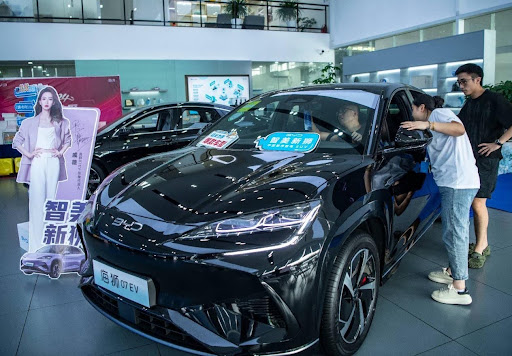
Hainan is on track to become the first province-level region in China to halt the sale of new gasoline-powered vehicles.
According to a plan recently issued by the Hainan provincial government, the province will gradually phase out fuel-powered vehicle sales by 2030.
By that time, all newly added and replacement vehicles in the province’s public service and social operation sectors, excluding special-purpose vehicles, will be clean energy vehicles. Similarly, all newly purchased and replacement private motor vehicles will be new energy vehicles (NEVs). The province also aims to maintain a vehicle-to-charging-pile ratio of no more than 2.5 to 1.
Li Ziwen, an associate research fellow with the department of policy consultation at the Academy of Macroeconomic Research, noted that the policy applies only to the sale of new gasoline-powered vehicles after 2030 and will not affect vehicles already on the road.
Existing vehicle owners will retain their legal rights. Gasoline-powered vehicles registered before the policy takes effect may continue to operate normally, undergo regular inspections, and be legally transferred until the end of their service life. The policy does not mandate scrappage or impose usage restrictions on current gasoline-powered vehicles.
Why is Hainan phasing out gasoline vehicle sales? As early as 2019, Hainan became the first provincial-level region in China to explicitly set a target for phasing out gasoline vehicle sales, as part of its clean energy vehicle development plan.
According to Li, Hainan’s status as a national ecological civilization pilot zone and an international tourism destination makes environmental protection a core competitive advantage.
Promoting NEVs while phasing out new gasoline vehicles sales aligns with the province’s commitment to green, low-carbon development and helps preserve its renowned natural environment of blue skies, clear seas and sandy beaches.
Why is Hainan taking the lead?
Analysts point to several unique advantages that make Hainan a suitable testing ground for this transition.
First, the province sees consistently high temperatures year-round, largely avoiding issues such as reduced power battery output and diminished driving range that affect battery electric vehicles in colder climates.
Second, Hainan’s land area of 35,400 square kilometers. The highway distance from Haikou to Sanya is less than 300 kilometers, and a full loop around the island runs under 1,000 km. Based on the driving range of flagship models from mainstream NEV brands available today, residents can complete most one-way trips on the island with zero or just one charging stop.
Charging infrastructure is also well established across the island.
Hainan has made significant progress in developing itself into a clean-energy island, with new energy now its primary power source. Among all provincial-level regions in China, Hainan ranks first in NEV market penetration and second in NEVs as a share of total vehicle stock.
Official data show that, as of August 2025, Hainan had installed more than 230,000 charging piles and built 4,895 charging stations, bringing the vehicle-to-charging-pile ratio down to 2.1 to 1. Charging facilities now cover all expressway service areas and every township across the province.
The latest plan also sets a clear target for NEV ownership. By 2030, NEVs are expected to account for 45 percent of all vehicles in Hainan, up from 23.75 percent in 2025.
The ambitious target reflects the rapid rise in public acceptance of NEVs. Nationwide, data from the Ministry of Commerce show that the market penetration of new energy passenger vehicles increased from 5.7 percent in 2020 to 53.9 percent in 2025.
In Hainan, data from the provincial department of industry and information technology indicate that 116,800 NEVs were sold across province in 2025, accounting for 62.9 percent of all newly registered vehicles that year.
Will other regions in China follow Hainan’s approach?
Expects believe Hainan’s approach is unlikely to be directly replicated elsewhere in China because of differing local conditions.
In many inland areas, vehicles frequently across provincial boundaries. A blanket ban on new gasoline vehicle sales could trigger cross-provincial buying sprees of fuel-powered vehicles, driving up regulatory costs and significantly undermining the policy’s effectiveness.
In addition, regions such as northeast China, the Yangtze River Delta and central China still have relatively complete conventional automobile manufacturing supply chains. A comprehensive sales ban could affect industrial stability and employment. Northern China’s colder winters also pose additional challenges for battery performance and electric vehicle operation.
As a result, different regions will need to formulate policies suited to their own conditions rather than adopting a one-size-fits-all approach.
Hainan’s decision sent multiple positive signals. Li said it demonstrates China’s commitment and capacity to advance its carbon peaking and carbon neutrality goals by promoting deeper decarbonization in the transportation sector.
At the same time, it provides valuable experience for other regions in areas such as policy design, infrastructure development, consumer guidance and industrial transformation as China pursues vehicle emission reductions in a phased and region-specific manner.


Hainan set to become China’s first province to phase out gasoline vehicle sales