









By Xu Jing, People’s Daily
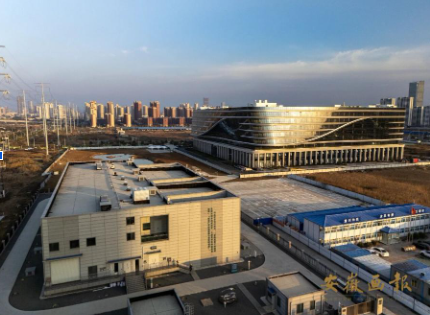
Quantum technology is beginning to transform the way China’s power grids operate. At the 220-kilovolt Houdian Quantum Application Demonstration Substation in Hefei, east China’s Anhui province, a suite of advanced quantum technologies is now in use. These include diamond-based quantum sensing materials to monitor current fluctuations, quantum-dot gas sensors to detect potential cable fire hazards and partial discharge faults inside switchgear, and other innovations that strengthen the intelligence, safety, and efficiency of grid operations.
Commissioned in November 2024, the facility is China’s first demonstration substation dedicated to the systematic application of quantum technologies. It has deployed 85 independently developed quantum devices across 18 categories, covering quantum sensing, quantum communication, and quantum computing.
The project represents a pioneering effort to integrate quantum technologies into power grid engineering, offering a new technological solution to the challenges faced by conventional power grids while supporting the development of a new-type power system.
The substation also represents a new generation of fully unattended intelligent substations.
“We have replaced many manual inspection tasks with high-precision quantum sensing equipment,” said Tian Teng, a young engineer at the digitalization institute of the electric power research institute under State Grid Anhui Electric Power Co., Ltd. “The new system can identify and diagnose equipment defects much faster, reducing both inspection costs and operating expenses.”
Inside the high-voltage switchgear hall, rows of power equipment operated steadily. Standing beside an out-of-service switchgear cabinet, Tian pointed to a small device mounted on its side.
“This is a quantum-dot multi-parameter sensor,” he explained. “It continuously monitors the cabinet’s internal environment and detects signals associated with partial electrical discharge, enabling us to assess the condition of the switchgear.”
He then pointed to another compact device attached to a cable beneath the cabinet.
“This is a distribution network current sensor. It monitors line loading in real time and can quickly and accurately locate faults along the transmission line.”
Quantum technologies are embedded throughout the facility — not just in these compact sensing devices.
Quantum technologies are embedded throughout the facility — not just in these compact sensing devices. A quantum lidar system installed on the rooftop monitors atmospheric particles and cloud conditions within a 15-kilometer radius, providing early warnings of weather-related risks. Quantum attitude sensors mounted on transmission towers can detect magnetic field changes as small as 1/10,000 of the Earth’s magnetic field, enabling highly accurate monitoring of tower alignment.
Besides, quantum encryption equipment supports both fiber-based quantum secure communications and “5G + quantum” encrypted communications, significantly enhancing cybersecurity across the power network.
The innovation extends beyond physical equipment. The substation has adopted a quantum computing-based approach for power flow analysis, which has been validated using the topology of a real-world power grid on Origin Wukong, China’s domestically developed quantum computer.
“This breakthrough provides an entirely new technical approach for large-scale power grid simulation,” Tian said. “It is expected to further improve the real-time analytical and computing capabilities of power systems.”
Why did China build this quantum-powered substation?
According to Tian, conventional power grids are increasingly facing three major challenges as renewable energy and power-electronics-based equipment become increasingly widespread: limited accuracy in equipment condition monitoring and delayed response; insufficient security for data transmission and control instructions; and the computational limitations of conventional computers when making rapid decisions for increasingly complex grid operations.
Developing a new-type power grid supported by quantum technologies has become an inevitable choice, he said.
Developing the necessary equipment, however, was far from straightforward.
There were no domestic precedents, no established standards and no mature technical solutions to follow, said Zhao Long, head of the power quantum sensing laboratory at the electric power research institute under State Grid Anhui Electric Power Co., Ltd.
“The biggest challenge came when supplies of high-quality diamond sensing materials were cut off by overseas suppliers, bringing the project close to a standstill,” he added.
The team eventually partnered with domestic materials researchers to develop customized alternatives. After repeated rounds of experimentation and testing, they achieved a breakthrough.
New engineering challenges soon emerged, including electromagnetic interference and adapting laboratory technologies to real operating conditions.
“For several consecutive months, we spent our days at the substation collecting data and tuning system parameters, and our nights back in the laboratory refining algorithms and improving packaging and shielding designs,” Zhao recalled.
“When the quantum current transformer finally displayed accurate readings on the monitoring screen, everyone on the team burst into applause. We had successfully bridged the ‘last mile’ from laboratory research to real-world engineering.”
According to project estimates, the application of quantum technologies enables the Houdian demonstration substation to reduce annual electricity measurement errors by more than 500,000 kilowatt-hours, while significantly improving the reliability and economic efficiency of grid operations.
Several quantum technologies first demonstrated at the substation have since been deployed elsewhere across Anhui province and are now being introduced to more regions across China.


Inside China’s first quantum-powered demonstration substation