









By Wang Jue, He Siqi, People’s Daily
Jingdezhen in east China’s Jiangxi province, has long been known as China’s “porcelain capital,” built its reputation over centuries through its world-renowned porcelain production. The enduring flames of its kiln have forged its millennia-old identity as a global hub of ceramic craftsmanship.
On July 25, at the 48th session of the UNESCO World Heritage Committee held in Busan, South Korea, China’s Jingdezhen Handicraft Porcelain Industry Sites were added to the World Heritage List, becoming the first World Heritage site themed around porcelain. The inscription marked China’s 61st World Heritage site.
The heritage property comprises five key components of Jingdezhen’s traditional porcelain industry into an integrated whole: the Town Area Porcelain Production Center, the Hutian Ancient Kiln Site, the Gaoling Porcelain Clay Mining Site, the Changling Porcelain Stone Mining Site, and the Jiaotan Firewood Production Area.
Together, these sites represent every major stage of the traditional porcelain production chain, from raw materials and fuel to manufacturing and transportation, providing a complete picture of the evolution of Jingdezhen’s handmade porcelain industry.
“The handicraft porcelain industry in Jingdezhen has endured for more than 1,000 years, far exceeding the lifespan of most traditional handicraft industries,” said Wei Qing, head of the team responsible for preparing Jingdezhen’s World Heritage nomination documents.
“It developed along two parallel paths: one centered on ceramic technology and artistic expression, and the other on an integrated industrial system. Together, they laid the foundation for Jingdezhen’s global influence and lasting market competitiveness,” Wei added.
Jingdezhen’s blue-and-white porcelain has long served as an important vehicle for spreading Chinese culture and a distinctive symbol of Eastern art. During the 17th and 18th centuries, it became an integral part of the Chinoiserie style that swept across Europe, profoundly influencing Western painting, furniture design, and architectural decoration while helping bring Chinese civilization and culture to the world, said Deng Chao, director general of the Department of Cultural Relics and Historic Sites under China’s National Cultural Heritage Administration.
Protecting the core heritage sites is essential to safeguarding Jingdezhen’s overall cultural heritage.
Inside the monitoring room of the Jingdezhen Ceramic Industry Heritage Protection Center, a giant digital screen displays real-time images from heritage sites across the city, allowing staff to monitor the condition of ancient kilns, historical docks, and other cultural remains at a glance.
Xu Guanxiang, head of monitoring at the center, explained that the city has established a comprehensive inspection system combining professional surveys with public participation. Tailored to the preservation needs of different sites, including klins and historical streets, the system ensures full monitoring coverage of every heritage location.
Building on these conservation efforts, Jingdezhen has gradually opened key heritage sites to the public, including the Imperial Kiln Factory Site, the Guanyinge Kiln Site, the Gaoling Kaolin Mine Site, and the Jiaotan Firewood Production Area. These spaces are designed to be open, walkable, and accessible, creating living heritage that connects archaeological sites, intangible craftsmanship, and cultural tourism experiences.
Today, Jingdezhen is working to ensure that heritage conservation is not only the responsibility of specialists but also a shared endeavor. The city is creating a model in which cultural heritage is jointly protected and enjoyed by the community.
Bringing millennial ceramic heritage into everyday life
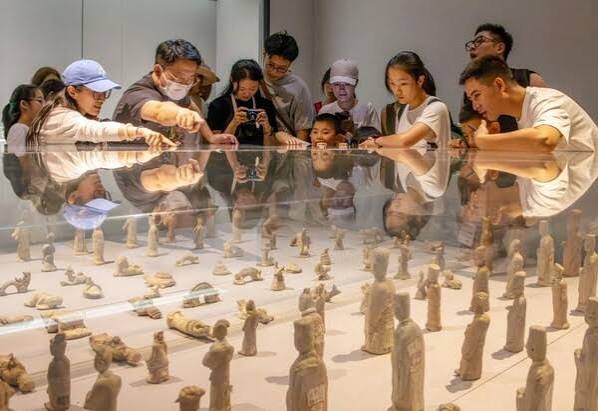
At the Jingdezhen Imperial Kiln Museum, more than 800 exhibits — including a tri-colored duck-shaped incense burner from the Chenghua reign of the Ming Dynasty (1368-1644) — showcase the city’s rich ceramic history. Beneath protective shelters covering the archaeological remains, visitors can observe the original production layers of the imperial kilns dating back more than 600 years from a remarkably close range.
Weng Yanjun, director of the museum, said the institution draws on its ancient ceramic “gene bank” to decode the wealth of historical information contained in countless porcelain shards, preserving the complete historical narrative of Jingdezhen’s raw materials, production, transportation, and everyday life, while helping visitors better appreciate the city’s millennium-old ceramic tradition.
Revitalizing heritage through digital technology
At each heritage site, visitors can scan a QR code with their smartphones to access a mini-program, which helps them navigate to porcelain heritage sites, join virtual heritage monitoring initiatives, and submit feedback on-site. This transforms visitors from sightseers into active guardians of cultural heritage.
“The valid reports submitted through the mini-program complement data collected by professional monitoring teams, creating a more comprehensive heritage protection information network,” said Zhou Lili, deputy director of the Jingdezhen Ceramic Industry Heritage Protection Center.
Inspiring a new generation to carry forward the kiln fire
In recent years, the city has established a variety of educational and cultural programs that aimed at encouraging young people to learn about, appreciate, and inherit its heritage.
Last year, eighth-grade student Zhang Ziyue was selected to become one of Jingdezhen’s “Young World Heritage Guides.”
“Every tour I give is another opportunity to deepen my understanding of my hometown’s history,” Zhang said. “I hope to become one of the new generation of guardians of the kilns, helping more people discover Jingdezhen and experience the charm of the Porcelain Capital through its historical streets and alleys.”
Connecting the world through porcelain
“I’ve always dreamed of coming to Jingdezhen. It’s a place where people can create freely,” said Pinar Guzelgun Hangun, a ceramic artist from Türkiye. “I’ve met many young Chinese artists here and experienced the constant exchange of techniques and creative inspiration.”
Today, more than 60,000 people have chosen to live and work in Jingdezhen as “Jing drifters,” including several thousand international artists. Together, they are carrying forward the city’s ancient tradition of handicraft porcelain while injecting fresh creativity and new vitality into the art.
As long as the kiln fires continue to burn, Jingdezhen’s cultural legacy will live on. With its successful World Heritage inscription marking a new beginning, Jingdezhen is poised to carry its millennium-old ceramic tradition into the future.


Kiln fires through millennia: Jingdezhen’s porcelain legacy shines for world