








By Chen Junyi, People’s Daily
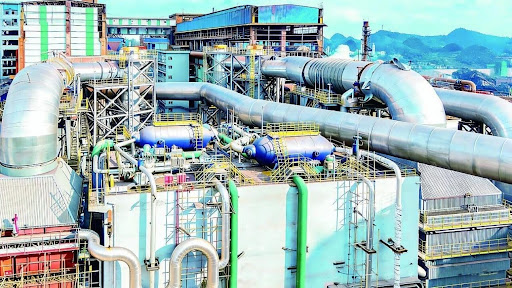
At a factory of Shougang Shuicheng Iron & Steel (Group) Co., Ltd. in Liupanshui, southwest China’s Guizhou province, a second 15-megawatt supercritical carbon dioxide (sCO₂) power generator was recently connected to the grid.
This marks the dual-unit commissioning of the “Chaotan One,” the world’s first commercial-scale demonstration project of supercritical carbon dioxide waste heat power generation.
The first unit began commercial operation in December 2025. Since then, the technology has operated reliably on the steel production line for over six months, continuously converting industrial waste heat into clean electricity. This approach breaks away from the century-old method of generating electricity by boiling water to produce steam.
Inside the project’s central control room, dozens of monitoring screens display real-time operating data, including temperature and pressure.
Meng Wei, deputy director of the equipment engineering department at Shougang Shuicheng Iron & Steel, pointed to the monitoring dashboard while summarizing the project’s performance over the past six months.
“A single generator has produced more than 32.85 million kilowatt-hours of electricity in six months, all of which has been consumed by the steel plant,” he said. “Once both units reach full production capacity in August, they are expected to generate 15 million kilowatt-hours of electricity every month.”
The company had previously installed a conventional steam-based waste heat recovery power generation system in 2010. However, its electricity output was relatively limited and its waste heat utilization efficiency remained low, making a technological upgrade necessary.
At the same time, the Nuclear Power Institute of China under China National Nuclear Corporation was seeking commercial applications for its supercritical carbon dioxide power generation technology. Meanwhile, Jigang Group, based in east China’s Shandong province, had developed strong capabilities in engineering construction and project operation after restructuring.
The aligned needs of these three parties led to the launch of the world’s first commercial-scale demonstration project of supercritical carbon dioxide waste heat power generation in Liupanshui.
Unlike the conventional “water-to-steam” power generation process that has been used for more than a century, the “Chaotan One” replaces water with carbon dioxide as the working fluid for energy transfer.
“Traditional power generation essentially relies on boiling water. Water is converted into steam, which later condenses back into water, resulting in considerable energy loss,” Meng explained.
Carbon dioxide enters a supercritical state at around 31 degrees Celsius and 73 standard atmospheres of pressure. In this state, it combines the high density of a liquid with the low viscosity of a gas, significantly reducing energy losses during the power generation process.
Researchers have tackled over 200 technical hurdles. All relevant technologies are fully self-developed and domestically controllable. More than six months of on-site commercial operation has also rapidly boosted technological maturity.
Project data show that electricity generation reaches 36 kilowatt-hours per ton of sintered ore, roughly doubling the output of conventional advanced waste heat recovery systems used in the steel industry. The thermal-to-electricity conversion efficiency is 75 percent higher than that of traditional steam-based systems.
The technology is also well suited to the mountainous terrain of Guizhou’s mountainous terrain. Compared with conventional steam power units of the same capacity, the system occupies less than half the land area, eliminates the need for large cooling towers, and requires only two or three operators for routine maintenance.
“Over the past more than half a year, the system has demonstrated fast response, strong operational flexibility and ease of operation,” said Yang Luguang, an operations manager with Jigang Group.
For the steel producer, one of the most tangible benefits is lower electricity costs. Meng estimated that industrial electricity purchased from the grid costs about 0.65 yuan (about $0.1) per kilowatt-hour, while electricity generated by the “Chaotan One” from recovered waste heat costs roughly 0.5 yuan per kilowatt-hour. At full capacity, the project can save the company thousands of yuan in electricity expenses every day.
Based on an annual production of 5.6 million tons of sintered ore, the project is expected to reduce more than 50,000 tons of carbon dioxide emissions annually once fully operational.
According to Yang, many companies have already visited the project to explore potential cooperation.
The technology is suitable for recovering medium- and high-temperature industrial waste heat above 300 degrees Celsius, making it particularly well suited to energy-intensive industries. It could also be integrated with concentrated solar power and molten salt energy storage, offering broad prospects for wider industrial application.


New technology transforms industrial waste heat into clean electricity