











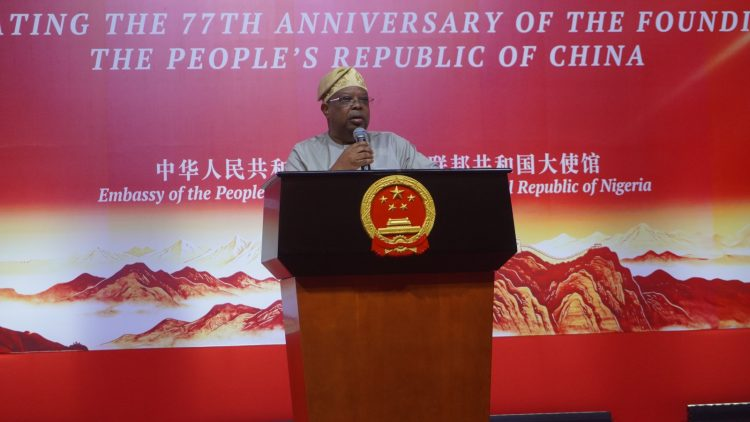
Nigeria is seeking deeper cooperation with China in the power sector to improve electricity supply, expand renewable energy development and strengthen local manufacturing of power equipment.
Minister of Power and Director-General of the Nigeria-China Comprehensive Strategic Partnership, Joseph Tegbe, made the call on Wednesday in Abuja at a reception organised by the Chinese Embassy to commemorate the 77th anniversary of the founding of the People’s Republic of China.


The event brought together Chinese Embassy officials, Nigerian government representatives, members of the diplomatic community, business leaders and journalists.
Tegbe said Nigeria saw significant opportunities to expand cooperation with China in electricity generation and supply, renewable energy and the local production of power equipment.
“As Minister of Power, I see particular promise in deeper cooperation on achieving reliable electricity, renewable energy, and manufacture of power equipment in Nigeria with our cooperation with China,” he said.
The minister stressed that Chinese investment should also support the development of Nigerian engineers and technicians and strengthen local enterprises capable of operating and maintaining infrastructure established through bilateral cooperation.
According to him, building local technical capacity alongside infrastructure development would help Nigeria develop sustainable national capabilities and derive longer-term benefits from its partnership with China.
Tegbe commended China’s contribution to Nigeria’s infrastructure development, citing projects including the Lekki Deep Sea Port, railway modernisation and the Zungeru Hydropower Station.
He also acknowledged Chinese cooperation with Nigeria in healthcare, people-to-people exchanges and technical training.
The minister welcomed China’s zero-tariff treatment for 53 African countries, saying the policy could create opportunities for Nigerian producers to expand their access to the Chinese market.
He noted that Nigeria and China had recently signed agreements covering the export of aquatic products to China, describing improved market access as an opportunity to increase domestic production and exports.
Tegbe reaffirmed Nigeria’s commitment to the One-China principle, saying the country’s relations with China were based on mutual respect and sovereign equality.
Also speaking, Chinese Ambassador to Nigeria, Yu Dunhai, said China was ready to deepen cooperation with Nigeria in industrialisation, digital development, and the green and blue economies.
Yu said China was prepared to align its 15th Five-Year Plan with President Bola Ahmed Tinubu’s Renewed Hope Agenda, describing the future of China-Nigeria cooperation as having “boundless potential.”
The ambassador also disclosed that bilateral trade between the two countries reached $18 billion in the first half of 2026, representing a 35 per cent increase compared with the corresponding period in 2025.
He added that Chinese imports from Nigeria rose by 81 per cent during the period.
Yu said China’s implementation of zero-tariff treatment for 53 African countries from May 1 had opened new opportunities for African exporters, noting that Chinese imports from Africa increased by 24 per cent in May and June.
According to him, the policy could help African countries convert their resource advantages into greater industrial capacity while supporting deeper economic integration.
Nigeria and China established diplomatic relations on February 10, 1971. In September 2024, President Bola Ahmed Tinubu and Chinese President Xi Jinping elevated bilateral relations to a comprehensive strategic partnership.
