









By Wang Zheng, People’s Daily
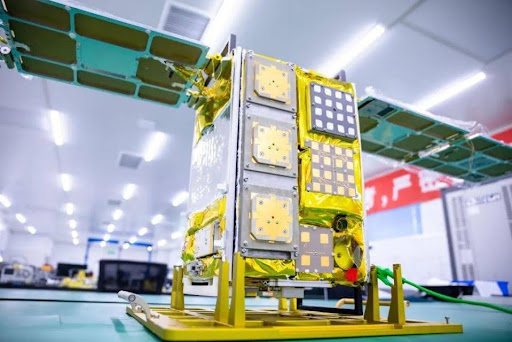
China is accelerating the development of space-based computing — an emerging technology that aims to move computing power from Earth into orbit. Once considered a futuristic concept, it is now entering the stage of real-world verification and deployment.
Earlier this year, commercial aerospace enterprise Adaspace Technology Co., Ltd. (ADAspace), together with Shanghai Jiao Tong University, successfully used space-based computing power to control a ground robot.
During the demonstration, a user issued commands in natural language from the ground. A large AI model deployed on an orbiting satellite processed the request, transmitted instructions through a space-to-ground communication link, and directed the robot to complete the assigned tasks.
It marked another milestone in China’s efforts to build a space-based computing infrastructure. Why is such a system necessary, and how does China plan to advance its development? People’s Daily spoke with experts to explore these questions.
“Space-based computing refers to a space information infrastructure built by deploying computing systems, data storage and high-speed communication facilities in orbit, integrating computing, storage and data transmission capabilities,” said He Baohong, chief engineer at the China Academy of Information and Communications Technology (CAICT).
The push to develop space-based computing is driven by three pressing needs.
The first is the widening gap between surging demand for computing power and constraints on energy resources.
Guo Liang, chief engineer at CAICT’s Cloud Computing and Big Data Research Institute, said the rapid development of generative AI has driven demand for computing power to grow exponentially. Statistics show that China’s data centers consumed 196 billion kilowatt-hours of electricity in 2025.
Ground-based data centers are increasingly constrained by high energy consumption, rising cooling costs and limited land availability. By relying on abundant solar energy in space for continuous power generation, space-based computing offers a new approach to addressing these challenges.
The second driver is the growing need for faster data processing.
Traditionally, satellite data have followed a “capture, transmit, then process” workflow, meaning that acquiring usable remote sensing data often takes several hours. In applications such as forest fire prevention, flood response, and maritime rights protection, every minute matters.
Wang Shangguang, dean of the School of Computer Science at Beijing University of Posts and Telecommunications, said his team’s Tiansuan Constellation uses onboard AI to process data directly in orbit, allowing key target information to be transmitted to Earth within minutes. In emergency response scenarios, this could shift disaster management from post-disaster rescue to pre-disaster early warning.
The third factor is the strategic importance of orbital resources and radio spectrum, both of which are limited and non-renewable.
As countries compete for these strategic resources, developing space-based computing has become not only an industrial priority but also an important component of digital infrastructure and security.
Guo said the development of space-based computing can be divided into three stages.
The first stage involves single-satellite computing. Individual satellites are equipped with AI computing modules with certain computing power to conduct preliminary processing on remote sensing imagery, including filtering, cloud removal, and target recognition, before transmitting valid data back to the ground.
The second stage is constellation networking, where multiple satellites are connected through inter-satellite links to form a space-based local area network. This enables distributed computing, dynamic resource allocation, and collaborative task processing across satellites.
The final stage is the establishment of a space computing network, in which dedicated large-scale computing nodes are deployed in orbit to form space-based computing clusters, enabling seamless integration between space-based and ground-based computing resources.
China’s space-based computing industry has now progressed from theoretical research to practical in-orbit verification and the initial deployment of computing satellite networks.
Technological validation has achieved key breakthroughs. China has completed in-orbit tests involving multiple satellites and successfully launched several experimental satellites equipped with edge-computing payloads, verifying the feasibility of using commercial-grade components in space.
It has also achieved major progress in inter-satellite communications, with independently developed laser communication links completing high-speed transmission tests between multiple satellites.
Satellite constellation deployment is entering a period of rapid expansion. Low-Earth-orbit broadband constellations, including the Qianfan Constellation, have entered regular launch operations. A new generation of satellites is being designed with reserved capacity for computing payloads, laying the groundwork for integrated communications, navigation, and remote sensing capabilities.
ADASpace has unveiled a plan that envisions deploying a network of 2,800 computing satellites. GalaxySpace, a leading provider of satellite Internet solutions and satellite manufacturer, has already launched more than 40 satellites and is developing a third-generation satellite platform specifically designed for space-based computing.
An integrated industrial ecosystem is taking shape. Organizations including a space computing professional committee and the Beijing Space Intelligent Computing Research Institute have been established, while the Beijing Space Computing Innovation Center has officially opened.
China has also released a list of 10 priority projects targeting key technologies for space-based computing. More than 10 leading companies, including LandSpace, GalaxySpace, ZTE, and BOE, are participating, covering the entire industrial chain from satellite platforms, chips, and payloads to networking, software, and applications.
Application scenarios are evolving from functional availability to superior usability. Space-based computing has seen initial progress in commercial adoption across consumer and industrial sectors. In emergency response scenarios such as forest fire prevention and flood management, remote sensing data processed via on-orbit computing enables minute-level disaster information distribution, forming an initial commercial closed loop.
“China’s greatest strength lies in its ability to coordinate resources across the entire industrial chain,” Guo said.
Drawing on its strong manufacturing base and enormous domestic market, China is pursuing a development path that deeply integrates communications, navigation, remote sensing, and computing into multifunctional satellite constellations.


Space-based computing: bringing data centers into orbit