








By He Linping, People’s Daily
Home to one of the world’s most complete and concentrated knitwear industrial clusters, Dalang township in Dongguan, south China’s Guangdong province, produces around 900 million sweaters each year — meaning roughly one in five sweaters sold worldwide is made here.
Its full industrial chain generates annual transactions exceeding 72 billion yuan ($10.64 billion), with products exported to more than 160 countries and regions, earning the township the title of the “World’s Knitwear Capital.”
But how did a township covering less than 100 square kilometers — and producing no wool of its own — built a globally competitive knitwear industry from scratch? A recent visit reveals the answer.
When people think of knitwear production, they often picture workers manually operating knitting machines, carefully guiding yarn as garments slowly take shape.
The production floor at Dongguan Xinhongfeng Garment Co., Ltd. tells a very different story.
Inside the company’s operations center, a massive video wall made up of four large LCD screens displays real-time feeds from more than 200 high-definition cameras. On the factory floor, rows of computerized seamless knitting machines operate in perfect order, with only a small number of workers move between the equipment.
“The company introduced over 20 computerized flat knitting machines in 2019,” said Lu Zhonghua, the company’s general manager. “Since then, we’ve steadily advanced our smart manufacturing transformation. Today, we operate more than 500 fully integrated seamless knitting machines.”
Standing beside one of the machines, Lu pointed to a sweater slowly emerging from its base.
“Today, a single strand of yarn is turned into a finished garment in no time, and that is a routine. For a relatively conventional design like this, it takes only about 50 minutes to complete,” Lu said.
Dalang’s knitwear industry dates back to the late 1970s. Over more than four decades, it has weathered changing domestic and international markets by embracing innovation and transformation. In recent years, digital upgrading has become a key driver of growth.
Today, businesses across the township operate 150,000 computerized flat knitting machines, including more than 10,000 high-end seamless knitting machines.
In the design department of the company, designer Tang Lanyan was having a conversation with an AI-powered design assistant.
“Make the colors lighter and more energetic.”
“Lengthen the sleeves slightly.”
As each instruction was given, the system instantly generated updated design sketches. It not only provided 360-degree visualization but also simulated how the finished garment would look when worn.
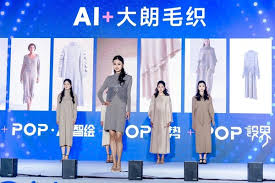
At the China (Dalang) International Woolen Knitwear Fair held in June, an AI large language model designed specifically for knitwear attracted considerable attention.
Built on a database containing more than two million knitwear design images, the model can generate multiple design proposals within one to two minutes after a designer enters a few keywords, reducing design costs by more than 60 percent.
Integrated with intelligent manufacturing systems, it has also shortened sample production from three days to just two hours, enabling creative ideas to be translated into market-ready products far more quickly.
A few streets away, at Tongfa Knitwears, company chairman Liu Dianyu and technical director Zhang Ruibin were discussing how to improve production efficiency.
“Ten hours is still too long to knit this piece,” Liu said. “Can we optimize the process and bring it down to eight?”
Just days earlier, an American client had sent over a design for a knitted dress featuring openwork shoulders, a finely knit upper section and seven or eight rows of circular cutouts that gradually increased in size toward the hem, creating an elegant yet contemporary look.
“But knitted garments are made by weaving yarn rather than cutting fabric,” Zhang explained. “The more intricate the pattern, the greater the technical challenge.”
The engineering team worked through the night, breaking down the design into individual production steps, developing a knitting solution, programming the computerized knitting machines and repeatedly refining prototypes until they produced a satisfactory sample.
“Dalang’s knitwear industry has moved well beyond the traditional model of mass production and competing on volume,” Liu said.
“At Tongfa Knitwears, we focus on high-end products rather than the low-end market. Our annual sales are growing by 20 to 30 percent. About 70 percent of our products are exported to Europe and the United States, with the factory price for each garment ranging from $25 to US$30.”
Inside the company’s showroom, sweaters made from a wide range of materials, in different colors and styles were displayed.
“Almost every design here is developed specifically to meet international fashion trends, and the overwhelming majority are created in-house,” Liu said.
To support innovation, the company has established a design and product development team of more than 100 people, accounting for 1/3 of its workforce. Product development alone represents about half of the company’s total operating costs.
“Our next step is to establish a design studio in Europe and collaborate with well-known local designers on co-branded collections,” he said.
Innovation in Dalang extends beyond garment design to the very materials used in production.
Each year, local companies develop nearly 10,000 new yarn varieties, including a growing range of functional fibers and environmentally friendly materials that have expanded well beyond the traditional definition of wool knitting.
Yarn producers in the township now hold more than 200 patents, over 80 percent of which relate to specialty yarns. These account for roughly 2/3 of all specialty yarn patents in China.
“Driven by innovation in technology, business models and materials, Dalang’s knitwear industry is moving rapidly toward the higher end of the value chain,” said Ye Jianfen, deputy mayor of Dalang township.


The Chinese township behind one in five sweaters sold worldwide