








By Shang Rongzheng, People’s Daily
If one word could sum up Turpan, a city in northwest China’s Xinjiang Uygur autonomous region, that word would be “hot.”
The city experiences temperatures above 35 degrees Celsius on more than 100 days each year. This July alone, daily temperatures exceeded 40 degrees Celsius on 20 days, while ground temperatures often climbed above 70 degrees Celsius.
The climate is not only scorching but also exceptionally dry.
Strong winds are common, and annual precipitation averages just 14.7 millimeters. However, annual evaporation reaches 2,477.5 millimeters.
Yet these once unforgiving natural conditions have become a driving force for industrial growth.
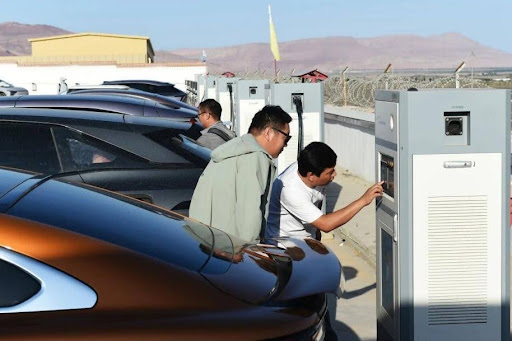
Every year from June to September, over 10,000 items made of plastic, rubber, metal, and other materials, alongside more than 1,000 new energy vehicles (NEVs), endure rigorous high-temperature trials in Turpan. This has given rise to a dry-heat testing industry with an annual output value exceeding 100 million yuan ($14.77 million).
Under the blazing summer sun, Zeng Wenbo, a test engineer at an NEV testing center operated by an automobile testing company under China Communications Construction Company Limited (CCCC), parked an electric vehicle on the open test ground. There, it began a 10-day outdoor exposure test.
“Before entering the market, NEVs generally undergo tests in high-temperature, extreme-cold and high-altitude environments,” Zeng said. “Turpan’s unique natural conditions make it one of the best locations for high-temperature, dry-heat testing.”
A closer look at the vehicle revealed dozens of sensors attached to the dashboard, steering wheel, seats, door handles, and body panels. Each sensor is connected by wires to a monitoring terminal.
It’s like giving the vehicle dozens of thermometers, Zeng explained, adding that the sensors continuously monitor temperatures at all critical parts.
“The outdoor exposure test is conducted during the hottest hours of the day and lasts at least three hours per session,” Zeng told People’s Daily.
“The data collected helps manufacturers improve the heat resistance of vehicle components and develop better anti-burn protection measures,” he said.
After 10 days of exposure, the vehicle moves on to road testing, where engineers evaluate battery safety, vehicle power performance, cooling system durability, air conditioning performance, driving comfort, and the reliability of electronic systems and seals.
According to Yu Shengli, executive deputy general manager of the automobile testing company, the facility is China’s first third-party automotive testing ground specializing in high-temperature, dry-heat conditions.
“Compared with testing facilities built by individual automakers, we can provide a much broader range of testing services while helping manufacturers reduce costs,” Yu said.
The testing center has attracted more than 70 vehicle brands from over 50 automakers, with approximately 1,500 vehicles tested each year.
Today, Turpan is home to five high-temperature, dry-heat testing bases, which together conduct more than 90 percent of China’s automotive high-temperature testing.
The city’s testing capabilities now extend well beyond automobiles.
In 2025, the CCCC automobile testing company received approval to establish a dedicated low-altitude flight testing zone. The designated airspace covers a radius of 5 kilometers around the testing ground and extends up to 600 meters in altitude, allowing comprehensive testing of low-altitude aircraft.
Testing focuses on battery safety, flight control systems, electric propulsion performance, structural integrity, and sealing reliability.
With the buzz of spinning propellers, test engineer Luo Hao launched a drone designed for inspections of power grids, photovoltaic facilities, and highways.
This time, Luo brought two identical drones to Turpan. One would remain outdoors for three months for static testing, while the other was used for dynamic flight tests.
During static testing, engineers inspect structural components twice daily — once in the morning and once in the evening. They monitored not only the impact of high temperature and dry heat on these parts, but also whether drastic diurnal temperature variations could trigger thermal expansion and contraction.
“Dynamic testing simulates normal operations under extreme conditions, mainly involving fully loaded inspection flights,” Luo explained.
Extreme temperatures can affect motor cooling and the stability of flight-control chips, potentially causing battery temperature to rise and power output to decline during prolonged hovering.
Since the low-altitude testing zone was approved, more than 20 low-altitude aircraft have completed testing there.
Another major testing facility, the Xinjiang Turpan Natural Environment Test and Research Center, sits beneath the Flaming Mountains, or Huoyan Mountain, Turpan’s iconic red sandstone range famed as China’s hottest terrain.
At this facility, rows of prefabricated test chambers house air conditioners from different manufacturers and models, all undergoing high-temperature, dry-heat performance testing.
“Extreme heat has a significant impact on air conditioning performance,” said Xu Ce, a test engineer with a testing company. “Our primary task is to verify whether air conditioners can achieve their rated cooling performance under high-temperature, dry-heat conditions, with particular attention to their cooling efficiency.”
The Xinjiang Turpan Natural Environment Test and Research Center is China’s largest outdoor natural testing base for dry-heat environments. It is capable of testing eight categories of products, covering 31 product types and more than 300 performance indicators, including automobiles, metals and alloys, plastics, and other industrial products.
Nearby, rows of photovoltaic panels are also undergoing testing under the intense summer sun.
“Each group of solar panels is connected to a data collection unit that continuously records electricity generation from four panels connected in series,” said Guo Chunyun, deputy director of the center. “We also regularly remove the panels and send them to the laboratory to measure power output and generation efficiency while inspecting their physical condition.”
At present, 10 photovoltaic companies have entrusted the center with testing their products. To date, the center has conducted tests on more than 42,000 products, providing valuable data for developing standards on natural aging in dry-heat environments as well as advancing testing technologies and methodologies.


Turpan turns extreme heat into thriving testing industry