











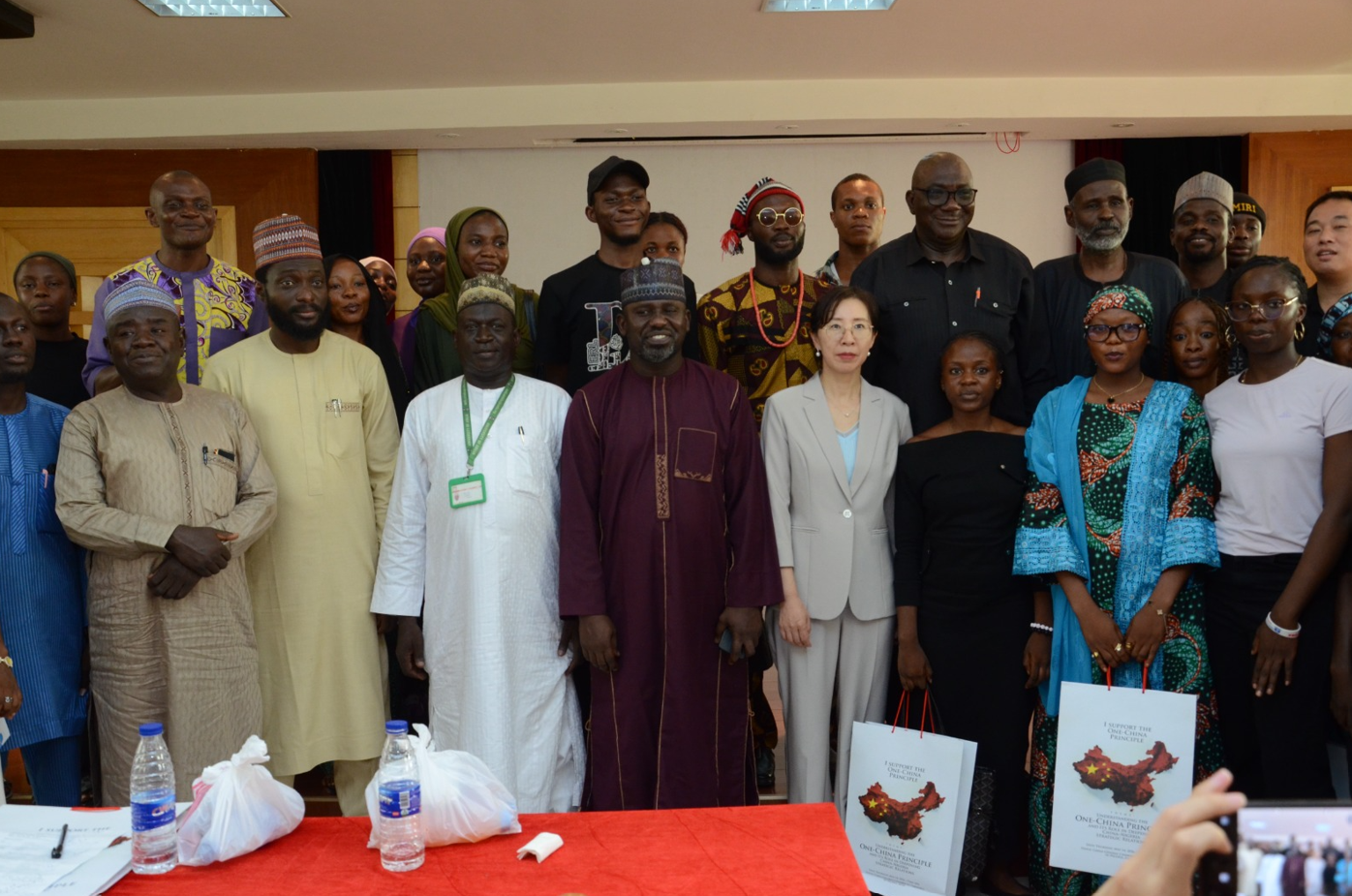

Stakeholders in diplomacy, academia and the media have reaffirmed Nigeria’s commitment to the One-China Principle, describing it as the foundation of the long-standing strategic partnership between Nigeria and China.
The position was reiterated during a media salon on the One-China Principle held at the China General Chamber of Commerce in Nigeria in Abuja under the theme, “Understanding the One-China Principle and Its Role in Deepening China–Nigeria Strategic Relations.”
The event was organised by the Centre for China Studies and the Centre for Contemporary China-Africa Research in collaboration with the Chinese Embassy in Nigeria.
Speaking at the event, Dong Hairong said the international community must maintain clarity on the Taiwan question and resist what she described as separatist propaganda promoting Taiwan independence.
She maintained that Taiwan has historically been part of China and that the People’s Republic of China remains the sole legitimate government representing China under international law and United Nations Resolution 2758.
According to her, Nigeria has consistently recognised Beijing as the only legitimate government of China since diplomatic relations were established in 1971.
Dong Hairong recalled that during President Bola Tinubu’s state visit to China in September 2024, Nigeria reaffirmed support for China’s sovereignty and territorial integrity, including recognition of Taiwan as an inalienable part of China.
She described the One-China Principle as the political foundation of China-Nigeria relations, noting that bilateral ties have expanded significantly in infrastructure, trade, and economic cooperation.
Highlighting recent cooperation, she cited the handover of the new ECOWAS headquarters complex in Abuja built with Chinese assistance, alongside China’s zero-tariff policy for exports from 53 African countries with diplomatic ties to Beijing, including Nigeria.
According to her, the policy is expected to create wider access for Nigerian agricultural products such as cocoa, sesame, ginger, and cashew nuts in the Chinese market.
She also urged Nigerian journalists to adopt accurate terminology when reporting Taiwan-related matters, cautioning against descriptions suggesting Taiwan is a sovereign state.
Also speaking, Sheriff Ghali Ibrahim said global support for the One-China Principle remains overwhelming, noting that 53 out of 54 African countries officially recognise Beijing.
He argued that Taiwan does not qualify as a sovereign state under international law and praised China’s approach to pursuing peaceful reunification under the “One Country, Two Systems” framework.
Prof. Ghali also criticised Eswatini for maintaining diplomatic relations with Taiwan, expressing optimism that the country would eventually align with the broader African consensus supporting Beijing.
Providing a legal and diplomatic perspective, Sam Amadi explained that the One-China Principle and the One-China Policy are related but distinct concepts.
According to him, the One-China Principle reflects Beijing’s claim that there is only one China under the sovereignty of the People’s Republic of China, while the One-China Policy describes how other countries manage diplomatic and economic relations around that position.
He noted that many countries maintain what he described as “strategic ambiguity” by recognising Beijing diplomatically while still engaging Taiwan commercially.
Amadi advised African countries to avoid formal diplomatic recognition of Taiwan while carefully managing trade and investment engagements to remain consistent with international obligations.
He also acknowledged China’s growing influence across Africa, especially in infrastructure development and regional integration projects, describing Beijing as one of Africa’s most significant development partners in recent decades.
Other speakers, including Charles Onunaju, Segun Showunmi, and Mukhtar Imam, called for stronger public understanding of the One-China Principle and deeper Nigeria-China cooperation in trade, infrastru
cture, cultural exchange, and diplomacy.
